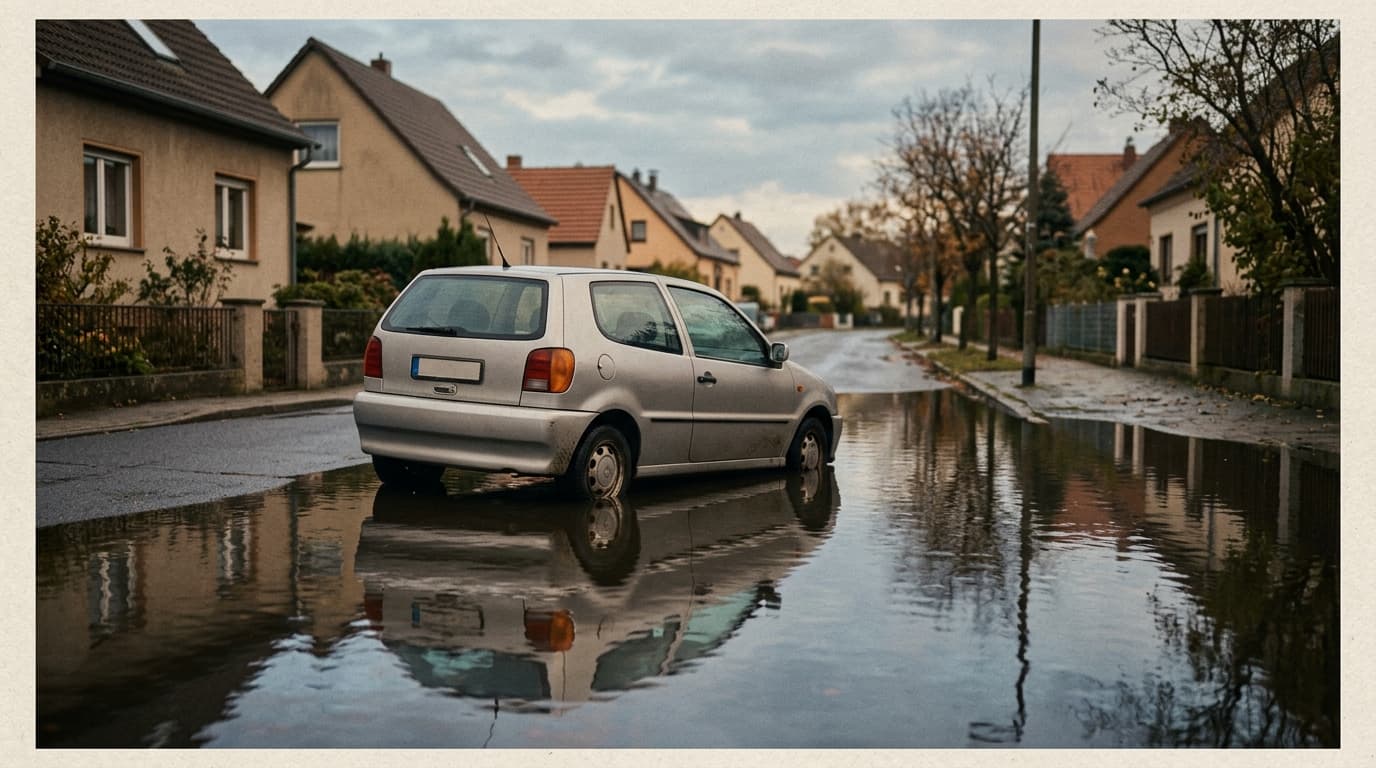
Yes, a flooded car is covered, provided your contract includes the natural forces cover, found in mini omnium as well as in full omnium. With third party liability alone you pay everything. But the price of that cover is not the variable that decides. Three lines of the contract do, and most drivers have never read them.
A few Belgian terms for readers new to the market. Omnium is the Belgian name for comprehensive cover: mini omnium covers external risks such as theft, fire, glass and natural forces, while full omnium adds damage to your own car when you are at fault. The bonus-malus is a 0-22 scale on which each at fault claim moves you up and each claim free year moves you down. Insurance premium tax is already included in the premiums quoted below. The FSMA is the Belgian financial services and markets authority, which licenses insurers and brokers.
Is a flooded car covered by car insurance?
Only by omnium, in one form or another. Compulsory third party liability pays for the damage you cause to others, never for what water does to your own vehicle.
According to Test-Achats (file of 3 April 2024), flooding falls under the natural forces cover, included automatically in a mini omnium as in a full omnium. Home insurance does not cover cars. The law of 17 September 2005 made natural disasters compulsory in the fire insurance of homes, not in that of vehicles.
The table below sorts the most common situations.
| Situation | Cover that applies | Likely out of pocket | What to do |
|---|---|---|---|
| Third party only, car on the street | None from the car insurer | The value of the car | Disaster fund if the disaster is recognised and the car is 5 years old or more |
| Third party only, car in a garage | Vehicles at rest option of the home policy, if it exists | The value of the car otherwise | Re-read the home contract |
| Mini omnium or omnium, car parked | Natural forces | 0 € as a rule | Report, take photos, wait for the expert |
| Omnium, car driven into the water | Natural forces, subject to the direct damage clause | Variable, sometimes everything | Ask for the classification of the damage in writing |
Three lines of the contract weigh more than the premium
The thesis fits in one sentence: the price of the cover varies threefold from one insurer to another, but the gap in compensation after a flood comes from elsewhere.
First line: the definition of covered damage. Test-Achats reports that some contracts only cover the direct damage of the flood. A car caught by rising water is covered. A car whose driver went into a submerged street is less certainly covered, and the drowned engine is the textbook case.
Second line: the value used in case of total loss. A car that has soaked in water with its electronics drowned is very often an economic write off. The payout then depends on market or agreed value and on the depreciation scale. Our article on total loss prices that gap.
Third line: the declared parking place. It decides the compensation route when there is no omnium, as we show below.
One reassuring point: the deductible is generally zero on this cover. At AG Insurance, however, the OmniNature formula applies 250 € when the car is not repaired at an approved garage, and nothing if it is or if the car is a total loss. The same formula covers storms from gusts of 80 km/h, and provides a replacement car during repair, or up to 6 days after a total loss.
How much does the cover cost against a total loss?
Between 60 and 467 € a year, and the right reflex is to divide the premium by the insured value. The result is the yearly risk of total loss above which the cover pays for itself. It is not a measured probability, it is an arithmetic threshold.
I apply it to the standard depreciation of 1 % a month after a six month waiting period, on the 33,193 € Golf of the public Mon-Assurance-Auto grid recorded on 26/01/2026. The insured values come from our article on the cost of omnium.
| Annual premium | 4 year old car (19,252 €) | 6 year old car (11,286 €) | 8 year old car (3,319 €) |
|---|---|---|---|
| Natural forces only, 60 € | 0.31 % | 0.53 % | 1.81 % |
| Cheapest mini omnium block, 185 € | 0.96 % | 1.64 % | 5.57 % |
| Average mini omnium block, 308 € | 1.60 % | 2.73 % | 9.28 % |
| Most expensive mini omnium block, 467 € | 2.43 % | 4.14 % | 14.07 % |
Reading it. On an eight year old car, the average block of 308 € requires a yearly total loss risk of 9.3 % to pay for itself. Flood risk alone rarely reaches such a level. On the same car at four years, the threshold falls to 1.6 %. And if the block were only there to cover water, the 60 € formula would sit below 2 % at every age.
Why not conclude that you should drop the cover on old cars? Because the 308 € block mostly pays for theft, fire and glass, as our article on hail details, and the decision is taken on the whole block. The 5 to 7 % of value rule, set out in our guide to mini omnium or full omnium, remains the right referee.
The objection: "I do not live in a flood zone"
It is reasonable, and it turns against you. A car moves. Monday's commute sometimes crosses the valley that your home avoids, and an underground car park is precisely the place that fills first.
The July 2021 figures are a reminder. More than 11,000 vehicles were destroyed or damaged in Wallonia, according to Region data quoted by L'Avenir on 15 July 2022. Insurers stepped in for only 6,922 vehicles under omnium or mini omnium. That makes at most 63 % of vehicles compensated by an insurer, so more than a third of the affected fleet was left to other safety nets. The exact number of motorists with no cover at all is not published, and I do not deduce it from those two figures.
Another marker, on the wreck side: according to Febelauto, 1,242 vehicles had reached approved recycling centres at the date of that article.
Without omnium, do the disaster fund and home insurance suffice?
They can complement each other, but never cover the same car. The third line of the contract settles it.
The two schemes share the ground according to where the car slept. The regional fund compensates cars hit in the street or on the road, not those in a garage or carport. The vehicles at rest option of home insurance targets the opposite, the garage and its immediate surroundings. No overlap, and a possible gap between the two if you took neither.
The fund has conditions, which Test-Achats lists:
- the disaster must be officially recognised as a natural calamity, and the application can only be filed after publication in the Belgian Official Gazette;
- the application must arrive before the last day of the third month following that publication, an early application not being valid;
- in Brussels and Wallonia, the car must be at least five years old;
- amounts and deductible are not published on the page cited, so I do not price them.
A flood claim does not, as a rule, touch the bonus-malus: the 0-22 scale only moves after an at fault claim, and water makes nobody liable. Same reasoning as for hail, with an out of pocket cost of zero in most contracts.
What should you do in the first hour?
Do not start the car if it is submerged, the one move that turns a repair into a wreck. Then, in order:
- photograph the car, the water level and the location;
- drain the water if that can be done safely, the fire brigade being able to help with an underground car park;
- call the insurer for towing, generally covered;
- report the claim to your omnium insurer, or to your home insurer if that route applies;
- let the expert visit before any repair.
The full procedure is in our guide to reporting a car insurance claim. On the replacement car, Test-Achats notes that insurers grant it less often than before, often on condition of using an approved garage.
Simulate the cover on your plate in the simulator, put formulas side by side in the comparison tool and find insurer by insurer detail in our ranking of the best car insurers.

Method, reference profile and sources
Reference profile of the site: a 35 year old driver, VW Golf 1.5 TSI, Flemish Brabant, no claims for five years, around 15,000 km a year. The premiums of 185, 308 and 467 € are our own subtractions on the public grids of Mon-Assurance-Auto (Yago S.A., broker licensed by the FSMA under number 114863), recorded on 26/01/2026 and consulted on 10/10/2026. Their simulated profile, a female driver born in 1968 with a diesel Golf in Walloon Brabant, differs from ours: only gaps and thresholds are transposable. The premium of 60 € a year (5 € a month) is that of AG Insurance's professional range, cited as a yardstick. The conditions of the fund and of home insurance come from Test-Achats (3 April 2024, modified 2 December 2024). The July 2021 figures come from L'Avenir (15 July 2022). The break-even thresholds are our own calculation, with depreciation of 1 % a month after a six month waiting period, a market convention and not a legal rule. Definitions: Wikifin and Assuralia.
This site compares and calculates. It does not sell insurance, is not an intermediary within the meaning of the Insurance Act of 4 April 2014 and gives no individual recommendation: speak to your insurer or an FSMA licensed broker. In case of dispute, the Insurance Ombudsman steps in free of charge. No link is affiliated.
Garanties & formules comparator
Compare all garanties & formules side by side.
Compare now →
Frequently asked questions
Damien décortique le marché belge de l'assurance auto depuis plus de dix ans. Ancien gestionnaire de sinistres en compagnie, devenu analyste indépendant, il lit les conditions générales ligne par ligne, compare les primes réelles de AG, Ethias, KBC, Belfius, P&V ou Corona Direct, et teste les simulateurs du marché. Sa conviction : beaucoup de Belges surpaient leur prime ou découvrent une exclusion le jour du sinistre, faute d'avoir comparé les garanties. Sur ce site, il traduit le jargon des contrats (RC, omnium, franchise, bonus-malus) en conseils concrets, chiffrés et sans lien commercial caché.