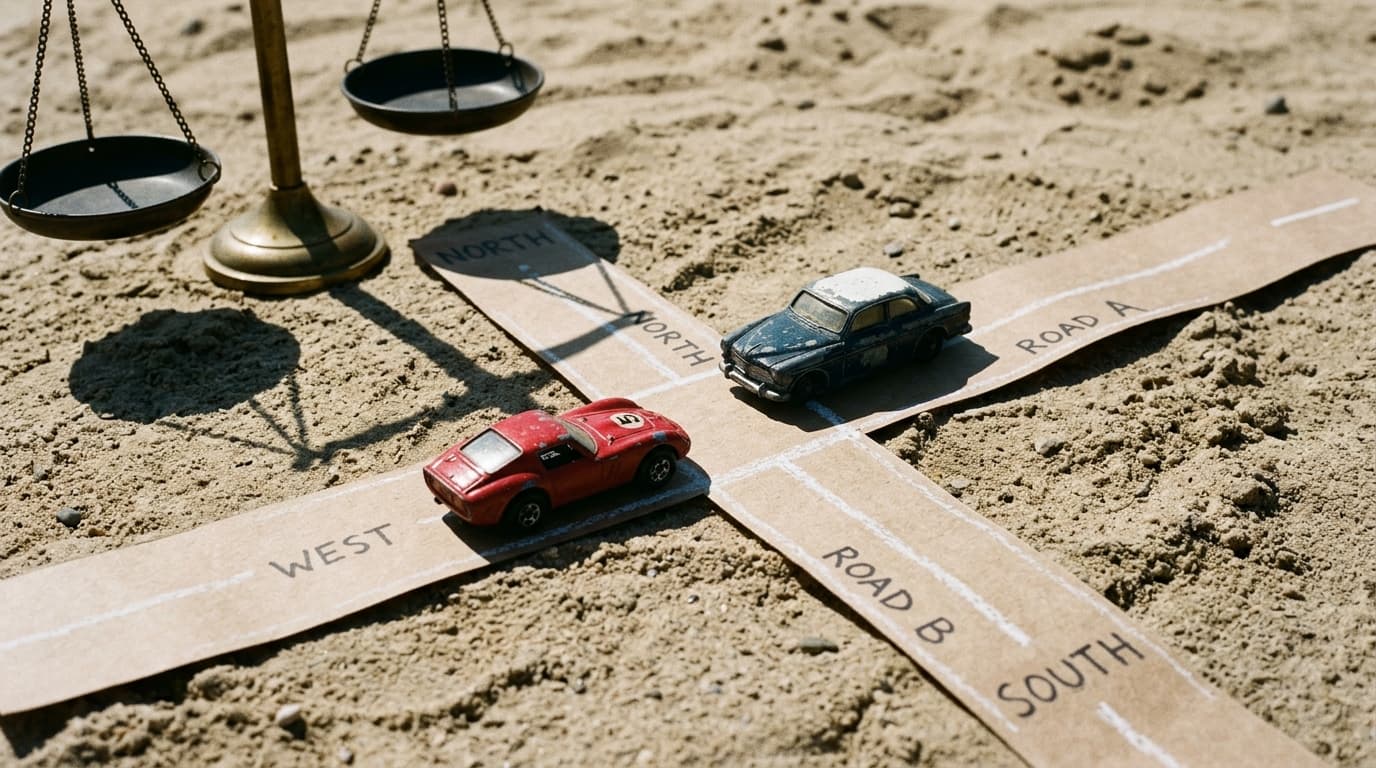
Shared fault has no single premium rule in Belgium, which is why its cost is so easy to ignore. On our reference profile, the same minor collision costs 706.00 € of extra third party liability premium over five years if the insurer counts it as full fault, 105.90 € if it merely freezes the degree, and nothing at all if the other driver is solely responsible.
What is shared fault in car insurance?
It is an accident where each driver bears part of the responsibility, often 50 % each, and where each third party liability policy repays the other party's material damage in proportion to its policyholder's share. The back to back settlement (dos-à-dos in French) is a neighbouring case: nobody can establish who caused what, and each insurer compensates its own policyholder.
That leaves the premium.
Does shared fault push up your bonus-malus?
It depends on which page you read, and that is the first fact to retain. Three Belgian sources, consulted on 03/10/2026, do not say the same thing. The bonus-malus is the Belgian scale of degrees, from 0 to 22, that raises or lowers your third party premium according to your at fault claims.
| Source | What it writes about shared fault |
|---|---|
| Selectra Belgium (page modified 21/05/2026) | Same 5 degree rise as full fault |
| assurance.be (updated June 2026) | A "generally lighter" effect than full fault, depending on the share retained and the insurer |
| HelloSafe Belgium (scale updated 20/03/2023) | No specific rule for shared fault: each insurer applies its own policy |
The contradiction is not an editorial slip, it comes from the law. Since 1 January 2004 the single bonus-malus scale has no longer been compulsory: each insurer sets its own scale, including how it treats shared responsibility. Our article on how the bonus-malus works covers the general mechanism. What matters for you is the word written on your statement: responsible, non responsible or undetermined.
How much does an at fault claim cost over five years?
706.00 € of extra third party premium for the reference profile, if shared fault is counted as full fault.
Here is the calculation. Average third party liability premium across nine insurers is 353 € at the lowest degree of the scale, which is 50 % of the base premium. The base premium, the 100 % coefficient, is therefore 706 €. Our 35 year old driver started at degree 11 and has five claim free years behind him: he sits at degree 6 (66 %), so he pays 465.96 € for third party cover. An at fault claim raises the degree by 5 instead of lowering it by 1, and he then needs to come back down one notch a year.
| Year | Degree without claim | Degree after claim | Premium gap | Extra third party cost |
|---|---|---|---|---|
| 1 | 5 (63 %) | 11 (85 %) | 22 points | 155.32 € |
| 2 | 4 (60 %) | 10 (81 %) | 21 points | 148.26 € |
| 3 | 3 (57 %) | 9 (77 %) | 20 points | 141.20 € |
| 4 | 2 (54 %) | 8 (73 %) | 19 points | 134.14 € |
| 5 | 1 (51 %) | 7 (69 %) | 18 points | 127.08 € |
| Total | 100 points | 706.00 € |
A hundred points of gap over five years: for this profile the claim costs exactly one full base premium, spread over five renewals. That is not a rule, just a coincidence of the scale at degree 6, but it gives an easy figure to remember.
If your insurer simply freezes the degree (6, 5, 4, 3, 2 instead of 5, 4, 3, 2, 1), the gap drops to 3 points a year, which is 15 points and 105.90 € over the period. No Belgian insurer publishes that rule for shared fault: it is a calculation assumption, not a recorded tariff.
Does the same claim cost everyone the same?
No, and the gap is considerable. With an identical base premium, everything depends on the starting degree.
| Starting degree | Profile | Extra third party cost over 5 years (full fault) |
|---|---|---|
| 0 | Eleven claim free years | 247.10 € |
| 6 | Reference profile | 706.00 € |
| 11 | Driver just starting out | 953.10 € |
At degree 0 the driver loses no bonus because he was already at the floor, he only climbs back to degree 5 and then comes down again, so the bill stays modest. At degree 11 each notch is worth more points, because the curve of the scale steepens towards the top. The most expensive claim is therefore not the best driver's, it is the youngest driver's.
At what damage level does reporting shared fault pay off?
In a 50/50 split, the other driver's third party insurer normally repays half of your material damage. Reporting pays off as soon as that half exceeds the premium surcharge: the threshold is twice the surcharge.
| Insurer's rule | Surcharge over 5 years | Threshold for damage to your own car |
|---|---|---|
| Full fault, degree 0 | 247.10 € | 494.20 € |
| Full fault, degree 6 | 706.00 € | 1,412.00 € |
| Frozen degree, degree 6 | 105.90 € | 211.80 € |
| Non responsible | 0 € | no threshold |
A 900 € bumper therefore does not justify a report if your insurer counts full fault at degree 6, whereas a 1,800 € wing does so comfortably. Keep one limit in mind: the other driver reports on his side, and your third party policy will have to pay half of his damage, so the option of reporting nothing almost never exists in a 50/50. The full procedure is in our article on reporting a claim, and the case with no third party is worked out in report a claim or pay out of pocket.
Does a non responsible claim raise the premium?
As a rule not through the degree: you are not penalised when you are the victim of an accident for which you are not responsible. Tariff indexation can still push the premium up with no link to your claim, as our article on the premium increase explains.
The degree does not move.
What should you check on the claim statement?
Four lines decide everything, and none of them appears in the amount repaid.
- The classification retained: responsible, non responsible or undetermined.
- The share of responsibility in figures, when the insurer states it (50/50, 70/30).
- The degree shown at the next renewal, compared with last year's minus one notch.
- The entry on the claims history certificate, which follows your record to your next insurer.

How do you challenge the split of fault?
With evidence, in the order in which it disappears: photos of the scene before the vehicles are moved, the signed accident report, witness details, then an expert report if the disagreement persists. Legal expenses cover can fund the expert and the recourse, and the Insurance Ombudsman handles unresolved disputes free of charge. The stakes justify the effort: reclassifying shared fault as non responsible saves up to 706 € of third party premium for the reference profile.
Method, reference profile and sources
The 353 € premium comes from the public third party liability grid of Mon-Assurance-Auto (Yago S.A., broker licensed by the FSMA, the Belgian financial services and markets authority, under number 114863), record dated 26/01/2026: the average of nine insurers for a woman born in 1968, at the lowest degree, driving a 85 kW diesel VW Golf in Walloon Brabant, under 10,000 km a year. That profile differs from the site's reference profile (35 year old driver, VW Golf 1.5 TSI, Flemish Brabant, no claims for five years): the absolute amounts are therefore not quotes, and only gaps and mechanisms are transposable.
The 706 € base premium is our own calculation (353 € divided by 0.50). The scale is the pre 2004 one, published by Selectra Belgium (page modified 21/05/2026) and confirmed on degrees 0, 5, 11, 14 and 22 by HelloSafe Belgium (updated 20/03/2023), both consulted on 03/10/2026. Insurers now apply their own scales: the calculations on this page describe a mechanism, they do not reproduce any insurer's grid. The frozen degree scenario and the 50 % split are calculation assumptions. The effect on omnium cover is not priced here. The legal framework is the Insurance Act of 4 April 2014, and the bonus-malus rules are summarised by the FPS Economy and by Wikifin.
This site compares and calculates. It does not sell insurance, is not an intermediary and issues no individual recommendation: for a specific case, speak to your insurer or an FSMA licensed broker. No link on this page is affiliated.
In short
Shared fault is judged not by the amount repaid but by the line that classifies it on your statement: from 0 € to 706.00 € of third party premium over five years for the reference profile, and from 247.10 € to 953.10 € depending on the starting degree. Reporting pays off from 1,412 € of damage to your own car when the malus is full. Reread the classification, challenge it if it is wrong, then run your own profile in the simulator. Put offers side by side in the comparison tool, and the ranking of the best car insurers details each company.
Garanties & formules comparator
Compare all garanties & formules side by side.
Compare now →
Frequently asked questions
Damien décortique le marché belge de l'assurance auto depuis plus de dix ans. Ancien gestionnaire de sinistres en compagnie, devenu analyste indépendant, il lit les conditions générales ligne par ligne, compare les primes réelles de AG, Ethias, KBC, Belfius, P&V ou Corona Direct, et teste les simulateurs du marché. Sa conviction : beaucoup de Belges surpaient leur prime ou découvrent une exclusion le jour du sinistre, faute d'avoir comparé les garanties. Sur ce site, il traduit le jargon des contrats (RC, omnium, franchise, bonus-malus) en conseils concrets, chiffrés et sans lien commercial caché.