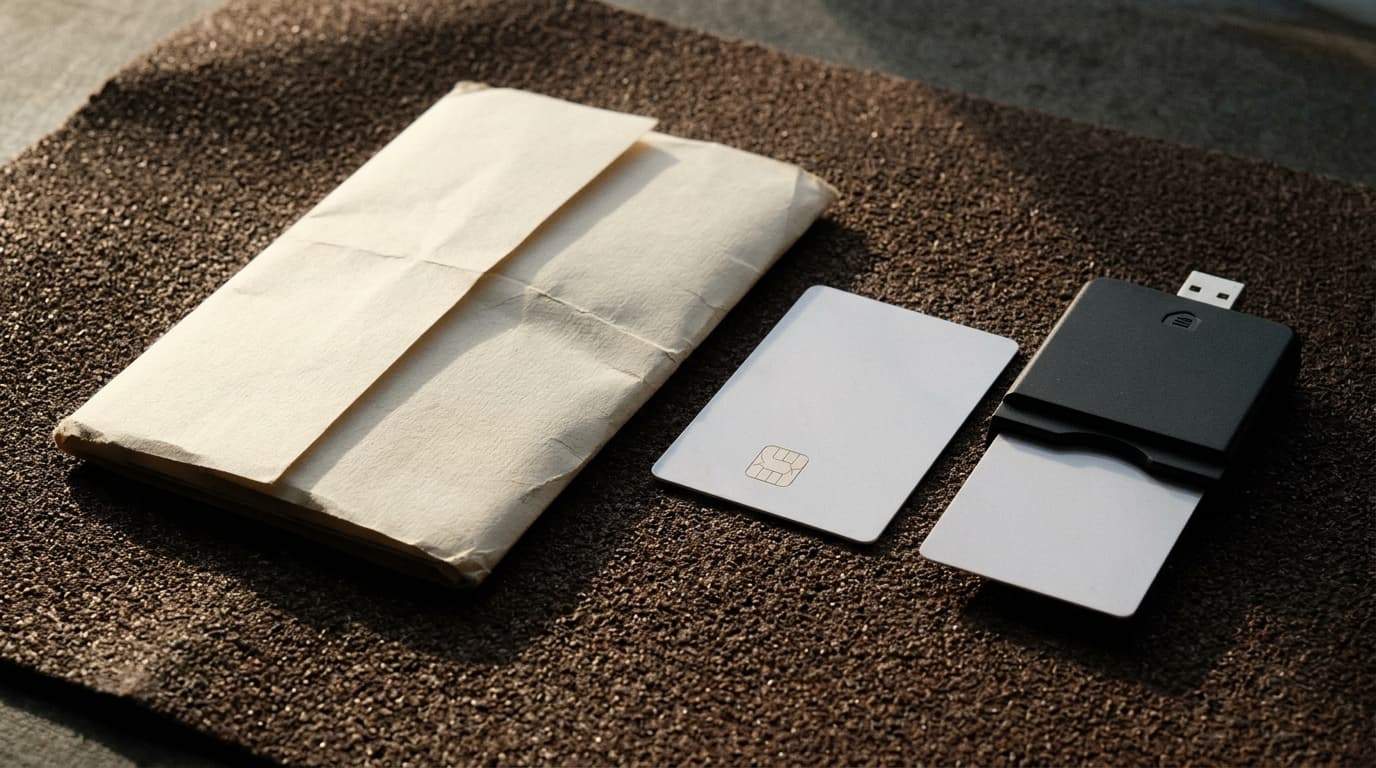
A free document, obtained online in minutes, worth 1,023.70 € to a driver at degree 2 and 1,313.16 € to a driver at degree 0. The attestation de sinistralité, the Belgian claims history certificate, is the best-paid piece of paper in a Belgian car insurance file, and the only one whose price nobody publishes. Here is the calculation.
What is a claims history certificate worth in euros?
Its value equals exactly what you would overpay without it. Lacking the certificate, a new insurer cannot take over your degree on the bonus-malus ladder, the Belgian no-claims scale running from 0 to 22 where a lower degree means a lower premium. It therefore treats you as a driver with no record: back to degree 11 for private use, then one step down per claim-free year.
The table below applies that mechanism to our reference liability premium of 353 € a year, recorded at the lowest degree, giving a base premium reconstructed at 706 € for 100 % of the scale.
| Your real degree | Coefficient | Premium with certificate | Premium without | Year 1 gap | Years to return | Value of the document |
|---|---|---|---|---|---|---|
| 0 | 50 % | 353.00 € | 600.10 € | 247.10 € | 11 | 1,313.16 € |
| 2 | 54 % | 381.24 € | 600.10 € | 218.86 € | 9 | 1,023.70 € |
| 4 | 60 % | 423.60 € | 600.10 € | 176.50 € | 7 | 663.64 € |
| 6 | 66 % | 465.96 € | 600.10 € | 134.14 € | 5 | 388.30 € |
| 8 | 73 % | 515.38 € | 600.10 € | 84.72 € | 3 | 169.44 € |
| 10 | 81 % | 571.86 € | 600.10 € | 28.24 € | 1 | 28.24 € |
The ratio between the first and the last row is 1 to 46. A driver at degree 10 can forget the certificate with little harm; a driver at degree 0 loses the equivalent of 3.72 years of liability premium.
The year-by-year calculation, on a driver at degree 2
Here is the full walk-through of the central case, done by hand. The driver sits at degree 2, switches insurer, and the certificate never reaches the new file handler's desk.
| Year | Degree applied | Coefficient | Liability premium | Surcharge that year | Cumulative |
|---|---|---|---|---|---|
| 1 | 11 | 85 % | 600.10 € | 218.86 € | 218.86 € |
| 2 | 10 | 81 % | 571.86 € | 190.62 € | 409.48 € |
| 3 | 9 | 77 % | 543.62 € | 162.38 € | 571.86 € |
| 4 | 8 | 73 % | 515.38 € | 134.14 € | 706.00 € |
| 5 | 7 | 69 % | 487.14 € | 105.90 € | 811.90 € |
| 6 | 6 | 66 % | 465.96 € | 84.72 € | 896.62 € |
| 7 | 5 | 63 % | 444.78 € | 63.54 € | 960.16 € |
| 8 | 4 | 60 % | 423.60 € | 42.36 € | 1,002.52 € |
| 9 | 3 | 57 % | 402.42 € | 21.18 € | 1,023.70 € |
| 10 | 2 | 54 % | 381.24 € | 0.00 € | 1,023.70 € |
Two readings come out of this table. Year one absorbs 21 % of the total bill, which keeps the problem invisible at the very moment it is created: two hundred euros more on an annual premium usually reads as a pricing difference between companies. The second is that the debt stretches across a decade, a period during which you will probably change insurer, car or municipality again, and where nobody will connect the surcharge back to its cause.
Reproducing the figure at home takes three operations. Divide your current liability premium by the coefficient of your degree to get the 100 % base. Multiply that base by the coefficient of every degree travelled between the fallback and your real degree. Add up the gaps.
Degree 11 or degree 14: which one do they place you at?
The reference scale has two entry points. Degree 11 for a privately used vehicle, degree 14 for professional use, and the gap between them is worth 105.90 € a year on our reference premium.
| Real degree | Fallback at degree 11 | Fallback at degree 14 | Cost of the wrong fallback |
|---|---|---|---|
| 0 | 1,313.16 € | 2,266.26 € | 953.10 € |
| 2 | 1,023.70 € | 1,892.08 € | 868.38 € |
| 4 | 663.64 € | 1,404.94 € | 741.30 € |
| 6 | 388.30 € | 1,002.52 € | 614.22 € |
The wrong fallback therefore costs almost as much as having no certificate at all. No Belgian page mentions this, and it takes one question to your broker to settle: which degree have you placed me at, and on which scale?
The certificate covers five years, your bonus took eleven to build
Here sits the hole in the Belgian system. The legal document lists claims from the last five years, not your full history. Yet descending from degree 11 to degree 0 requires eleven consecutive years without an at-fault claim. Six years of bonus therefore appear on no official document at all.
As long as your chain of contracts stays unbroken, the gap remains invisible: the outgoing insurer communicates the degree reached, the incoming one takes it over. Trouble starts when that chain breaks. An insurer that has left the market, a period without a vehicle, years spent abroad, a policy in the name of a deceased spouse.
In that case, a driver at degree 0 can only prove five clean years, which puts them at degree 6 rather than degree 0.
| Situation | Degree applied | Liability premium | Annual surcharge | Duration | Total cost |
|---|---|---|---|---|---|
| Unbroken chain | 0 | 353.00 € | 0.00 € | 0 | 0.00 € |
| Broken chain, 5 years proven | 6 | 465.96 € | 112.96 € | 6 years | 360.06 € |
| No proof at all | 11 | 600.10 € | 247.10 € | 11 years | 1,313.16 € |
Three hundred and sixty euros for a file everyone assumed was complete. The fix is simple and has to be taken in advance: download your certificate at the end of every contract and archive it yourself, since Car@ttest also keeps documents for five years only.
How do you obtain a claims history certificate?
Two routes, one immediate, the other framed by a legal deadline.
- Car@ttest, the platform created in 2013 by Datassur for the insurance sector, delivers the document online on the spot. You need a card reader, your electronic identity card and your PIN code. It covers certificates generated since 1 April 2013 at affiliated insurers.
- A direct request to your insurer, who has 15 days to respond. This route covers every insurer, including those not affiliated to Car@ttest and periods before 2013.
- The end of a contract, which triggers automatic dispatch of the certificate within 15 days, with nothing to do on your side.
- A request to each of your previous insurers if you have changed company during the last five years. The new insurer needs the whole period covered, and one certificate will not do that.
- An equivalent supporting document when no Belgian certificate exists: paperwork from a foreign insurer, proof of public transport subscriptions, medical certificates.
Free issue is not a commercial courtesy. It flows from article 7 of the Act of 21 November 1989 on compulsory motor liability insurance and from the royal decree of 14 December 1992, supplemented in 2002. If an intermediary invoices you for it, the invoice is not due, and the Insurance Ombudsman handles this type of dispute free of charge.
The same degree 0 is not worth the same at Ethias and on the reference scale
Since liberalisation in 2004, every Belgian company writes its own table, and the certificate does not set the premium: it establishes a record, which each insurer then converts using its own grid. That conversion changes a great deal.
| Grid | Coefficient at the lowest degree | Equivalent liability premium | Malus ceiling |
|---|---|---|---|
| Reference scale (0 to 22) | 50 % | 353.00 € | 200 % |
| Ethias | 45 % at degree 0 | 317.70 € | 219 % at degree 22 |
| Partners | 50 % at degree -3 | 353.00 € | 154 % at degree 22 |
| Belfius | floor at 50 %, 26-degree scale | 353.00 € | not published |
Thirty-five euros and thirty cents separate Ethias's degree 0 from the reference scale's, every year, on a rigorously identical record. The gap on the malus ceiling belongs to another order entirely: 1,546.14 € at Ethias against 1,087.24 € at Partners for a driver at degree 22, a difference of 458.90 € a year for the same driving mistake.
Several companies also add protection mechanisms that make the certificate even more profitable to produce. AG Insurance offers a turbo bonus at degree -2 for life after five claim-free years. Belfius grants a Fidelity Award on comparable terms. Baloise and Federale Assurance likewise apply a degree -2. These schemes trigger on proof of record, meaning on production of the certificate: without it, they are mechanically out of reach. The company-by-company detail sits in our ranking of the best car insurers.
Does your degree apply to your whole premium?
Bonus-malus modulates compulsory third-party liability, and nothing else. The distinction is decisive for anyone carrying comprehensive cover.
On our panel a full omnium, the Belgian name for fully comprehensive cover, runs to 1,135 € a year while liability alone costs 353 €. Your degree therefore moves 31 % of your bill. A driver at degree 0 pushed back to degree 11 sees the total premium go from 1,135 € to 1,382 €, a rise of 22 % rather than 70 %.
Two practical consequences. First, the certificate stays highly profitable, but its relative weight shrinks as you add cover, and shopping between insurers on the price of the omnium can return more than your degree: the detail of those spreads sits in our comparison of comprehensive insurance costs. Second, some contracts apply a separate scale to the own-damage cover, which can make that portion dearer after an at-fault claim. Your policy conditions say so, and they override any scale published elsewhere.
What if your certificate is wrong or incomplete?
It is wrong more often than people assume. A non-responsible claim recorded as at-fault, an incorrect date, a file opened then closed without payment but still listed: each of those errors is worth five degrees, so several hundred euros.
Check three fields on receipt. The date of occurrence of each claim, the liability recorded for each one, which should read engaged, not engaged or undetermined, and the amount actually paid to the third party. A file with no payment should not weigh on your degree, and it is the recorded classification, not the amount, that triggers the climb.
If you disagree, write to your insurer first, then refer the matter to the Insurance Ombudsman if no answer comes or the answer fails to convince. The FSMA, the Belgian financial services and markets authority, supervises the sector, and Wikifin, its financial education arm, publishes the relevant benchmarks. If every insurer turns you down, the Tariff Bureau remains the legal way out, at a markedly higher rate: we map that route in our guide to car insurance after cancellation or heavy malus.
Method, reference profile and sources
The 23-degree reference scale used in every calculation on this page is the table published by HelloSafe Belgium, consulted on 15/09/2026: degree 0 at 50 %, degree 11 at 85 %, degree 14 at 100 %, degree 22 at 200 %. It matches the single system in force before 1 January 2004 and has not been mandatory since that date, as confirmed by the FPS Economy and by Wikifin.
This site's reference profile: a 35-year-old driver, VW Golf 1.5 TSI, Flemish Brabant, no claims for five years, around 15,000 km a year. The liability premium of 353 € a year and the full omnium premium of 1,135 € a year are in-house averages calculated across the nine insurers appearing in the public grids of Mon-Assurance-Auto (Yago S.A., a broker registered with the FSMA under number 114863), recorded on 26/01/2026 and consulted on 15/09/2026. The profile simulated by that publisher differs from ours on age, province and mileage, and its liability premium corresponds to the lowest bonus-malus degree: only the gaps and ratios are claimed to transfer, and the 100 % base of 706 € is a reconstruction by division, not a recorded rate.
The entry degree of 11 for private use and 14 for professional use, the climb of five degrees per at-fault claim and the descent of one degree per claim-free year are documented by P&V and by the FPS Economy. The rules on obtaining the certificate, the 15-day deadline, the five-year coverage and the workings of the sector platform come from Datassur, which operates Car@ttest, and from the public page of Federale Assurance, both consulted on 15/09/2026. The coefficients specific to Ethias, Partners and Belfius, along with the turbo bonus at AG Insurance and the Fidelity Award at Belfius, are those published by HelloSafe Belgium on the same date; they are given as market benchmarks, not as binding contractual terms.
Stated assumptions: the model assumes an otherwise stable premium, no new claim during the rebuild period, and a scale matching the reference one. Annual premium indexation is not included, which slightly understates the cumulative figures. Rebuild durations are calculated at one degree per full calendar year. Note for readers new to Belgium: premiums advertised here are quoted inclusive of the Belgian tax on non-life insurance premiums, which rose to 9.6 % on 1 July 2026. This page compares and calculates. It does not sell insurance, is not an intermediary within the meaning of Belgian law and issues no individual recommendation: for a specific file, go to the insurer or to a broker registered with the FSMA. No insurer pays for its presence in this article, and no link on this page is affiliated.
In short
A claims history certificate is a free document worth between 28 € and 1,313 € depending on your degree, and up to 2,266 € if the fallback lands at degree 14 rather than 11. You get it instantly on Car@ttest or within 15 days from your insurer, and it only covers five years where a full bonus takes eleven, which makes archiving it at the end of every contract more useful than it looks. Check the liability recorded on every line before you hand it over. Then run a premium simulation on your real degree, put the offers side by side in the comparison tool, and the ranking of the best car insurers will give you the detail company by company. The mechanics of the degree itself are set out in our guide to bonus-malus in Belgian car insurance, and the cancellation steps in switching car insurance in Belgium.
Prix & primes comparator
Compare all prix & primes side by side.
Compare now →
Frequently asked questions
Damien décortique le marché belge de l'assurance auto depuis plus de dix ans. Ancien gestionnaire de sinistres en compagnie, devenu analyste indépendant, il lit les conditions générales ligne par ligne, compare les primes réelles de AG, Ethias, KBC, Belfius, P&V ou Corona Direct, et teste les simulateurs du marché. Sa conviction : beaucoup de Belges surpaient leur prime ou découvrent une exclusion le jour du sinistre, faute d'avoir comparé les garanties. Sur ce site, il traduit le jargon des contrats (RC, omnium, franchise, bonus-malus) en conseils concrets, chiffrés et sans lien commercial caché.