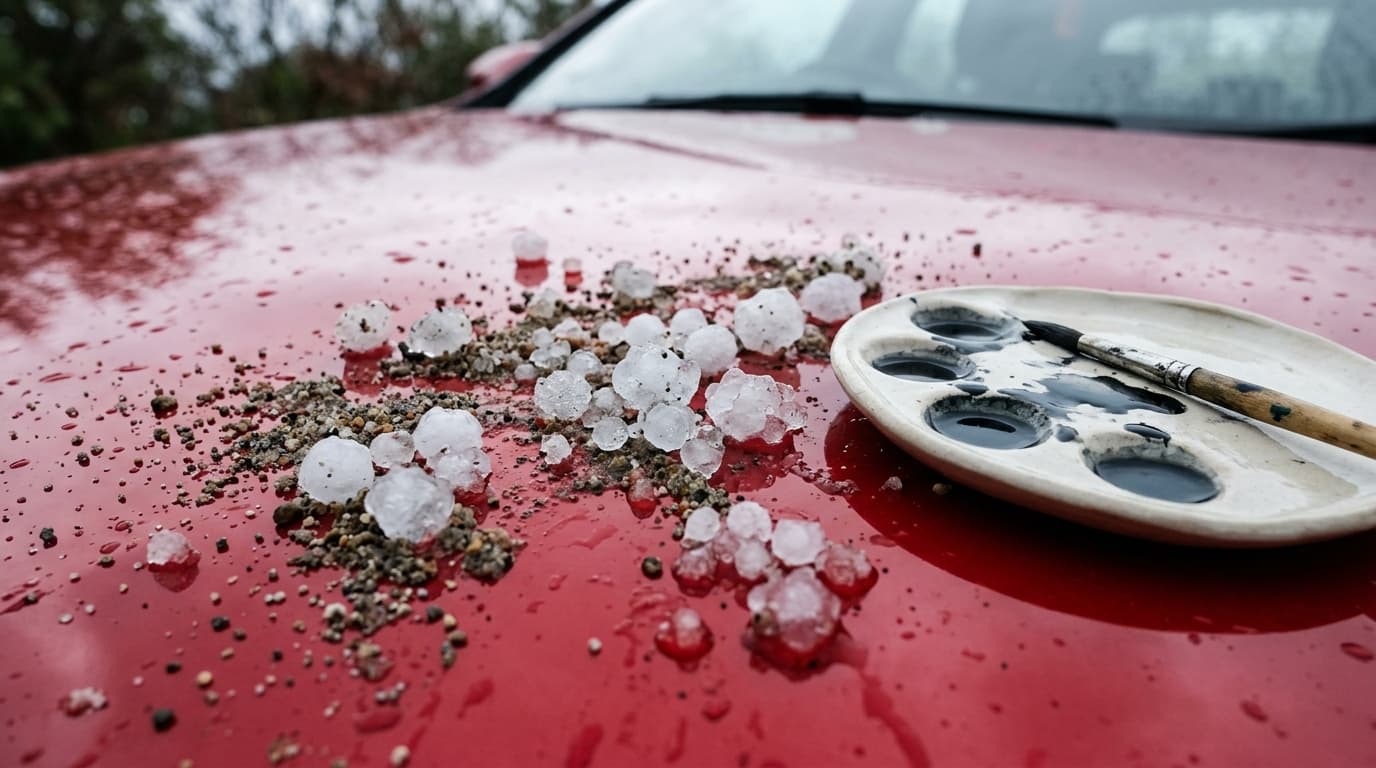
Yes, hail is covered, on one condition: your contract must include the natural forces cover, found in mini omnium as well as in full omnium. With third party liability alone the bill is yours, 2,743 € on average per car after the storms of 30 and 31 May 2026. With the cover, what you pay usually drops to zero, and your bonus-malus stays untouched.
A few Belgian terms for readers new to the market. Omnium is the Belgian name for comprehensive cover: mini omnium covers external risks such as theft, fire, glass and natural forces, full omnium adds damage to your own car when you are at fault. The bonus-malus is a 0-22 scale on which each at fault claim moves you up and each claim free year moves you down, with a direct effect on your premium. Insurance premium tax is already included in the premiums quoted below. The FSMA is the Belgian financial services and markets authority, which licenses insurers and brokers.
Is hail covered by car insurance?
Not by compulsory third party liability. It pays for the damage you cause to others, never for what the sky does to your bodywork.
Hail falls under the natural forces cover. Assuralia, the Belgian insurers' federation, states that it is normally included in mini omnium and full omnium alike, and that without it you bear the repair yourself. Whether the storm is officially recognised as a natural disaster makes no difference: omnium pays in both cases, according to the Test-Achats hail file.
One nuance that matters later: the cover targets the direct impact of the hailstone, not a skid on a road turned white with ice.
How much does it cost to repair a hail damaged car?
2,743 € on average. That is the cost estimated by Assuralia for the 26,156 omnium claims filed after the storms of 30 and 31 May 2026, with hail particularly intense in parts of Flanders. That single weekend produced more claims than the whole of 2025.
Technique drives the price. Paintless dent repair pushes the metal back from the inside and is usually billed from a few tens of euros to around a hundred euros per dent, a market range that no published price list lets us attribute. Once the paint has cracked, sanding and repainting are needed, and the bill changes scale.
Set against our reference profile, those 2,743 € equal 7.8 years of third party liability, which the public grid of nine insurers recorded on 26/01/2026 puts at 353 € a year on average.
How much does the cover for hail cost?
Between 60 and 467 € a year, depending on how you buy it. Most drivers pay for it inside the mini omnium block, which bundles theft, fire, glass breakage and natural forces: 308 € a year on average, the gap between mini omnium (661 €) and third party liability alone (353 €) on the same grid, broken down in our article on the cost of comprehensive cover.
| How you buy hail cover | Annual premium | Years of premium for a 2,743 € claim |
|---|---|---|
| Cheapest mini omnium block on the grid (ACM Insurance) | 185 € | 14.8 years |
| Mini omnium block, average of nine insurers | 308 € | 8.9 years |
| Most expensive mini omnium block on the grid (Ethias) | 467 € | 5.9 years |
| Natural forces only (AG OmniNature, professional range) | 60 € | 45.7 years |
The last row is a yardstick. AG Insurance sells its self employed clients a formula limited to natural forces for 5 € a month. It isolates the price of climate risk alone, and that price is less than a fifth of the average mini omnium block. The 308 € therefore mostly pay for theft, fire and glass; hail comes almost as a bonus.
To price that block on your own number plate, run the simulator. Formulas compare cover by cover on the comparison tool and in our ranking of the best car insurers.
Is there a hail deductible on a car?
As a rule, no. Test-Achats states that omnium generally carries no deductible on the natural forces cover, and P&V writes it in plain words for its own contracts.
The exceptions depend on the repairer. At AG Insurance, OmniNature applies no deductible when the car goes to an approved garage, in case of total loss or for a repair abroad; in every other case it applies 250 €. Choosing a body shop outside the network therefore costs 9.1 % of an average claim.
The deductible of 395.88 € or 791.75 € calculated in our guide to the omnium deductible does not apply to hail. It targets the material damage cover.
Does hail raise your bonus-malus?
No. The 0-22 bonus-malus scale only moves after an at fault third party liability claim, and a hailstone makes nobody liable.
Everything changes when hail causes an accident. You brake on a road covered in hailstones, the car slides and hits the one in front: your liability cover pays the third party, the claim is at fault, and your degree climbs five steps on the historical scale. Our bonus-malus guide prices that climb at 280 € in the first year on a 700 € base premium, from degree 6 to degree 11, with five claim free years to come back down. Your own damage is then only picked up by the material damage cover of a full omnium, deductible applied. With mini omnium it stays with you.
Should you claim for hail or pay out of pocket?
Claim. For an at fault scrape, the trade off sets the repair cost against the extra premium paid while your degree comes back down, and it sometimes favours paying yourself: our article on reporting a claim or paying out of pocket sets out the full calculation. For hail, the two terms that make that calculation interesting are both zero: no malus, and no deductible in most contracts.
Paying yourself means leaving 2,743 € on the table.
| Situation | Cover that applies | Out of pocket on an average claim | Effect on your degree | What to do |
|---|---|---|---|---|
| Parked car, third party only | None | 2,743 € | None | Body shop quote, paintless dent repair if the paint is intact |
| Parked car, mini omnium or omnium | Natural forces | 0 € as a rule | None | Claim, take photos, wait for the expert |
| Same case at AG OmniNature, repairer outside the network | Natural forces | 250 € | None | Choose an approved garage |
| Cracked windscreen, glass cover only | Glass breakage | 0 € through an approved firm at Yuzzu | None | Claim the glass, the bodywork stays with you |
| Skid on hailstones, no third party involved | Material damage, full omnium only | Contract deductible | None, liability cover pays nobody | Claim if the damage clearly exceeds the deductible |
| Skid on hailstones into another vehicle | Liability for the third party, material damage for you | Deductible, then malus | Plus 5 degrees | Claim, then price the malus over five years |
One caveat. Even with no effect on your degree, a hail claim enters your claims history, and how each company weighs it at renewal is a matter of commercial policy: ask the question in writing. The procedure itself is covered in our guide to reporting a car insurance claim.
Third party only: can a public fund pay?
Rarely for bodywork. According to Test-Achats, regional disaster funds never compensate purely cosmetic damage such as dents, and Brussels and Wallonia do not step in for a car under five years old. The application can only be filed once recognition of the disaster has been published in the Belgian Official Gazette.
Five lines to check in your contract before the next storm
- The natural forces cover: is it part of your mini omnium? The word has no legal definition and P&V itself invites you to check.
- The hail deductible: zero, or 250 € outside the network as at AG OmniNature?
- Indirect damage: is a skid on hailstones covered, or only the impact of the hailstone?
- The value used for a total loss: market value or agreed value, with which depreciation scale? Our article on total loss prices the gap.
- The replacement car: provided, and on what garage condition?

Method, profile and sources
Reference profile: a 35 year old driver, VW Golf 1.5 TSI, Flemish Brabant, no claims for five years, around 15,000 km a year. Average cost of 2,743 €: Assuralia press release of 12/06/2026, provisional estimate consulted on 26/09/2026. Third party liability (353 €), mini omnium (661 €) and mini omnium blocks (185 to 467 €): our own averages and subtractions on the public grids of Mon-Assurance-Auto (Yago S.A., broker licensed by the FSMA under number 114863) recorded on 26/01/2026, whose simulated profile (a female driver born in 1968, Golf Diesel, Walloon Brabant) differs from ours, so only gaps and ratios are claimed to be transposable. OmniNature (5 € a month, 250 € deductible): AG Insurance page consulted on 26/09/2026, a product for mixed use cars cited as a yardstick. Zero hail deductible: Test-Achats (19/03/2024) and P&V (15/10/2023); zero glass deductible through an approved firm: Yuzzu, page consulted on 26/09/2026. Definitions: Wikifin, the financial education portal of the FSMA.
This site compares and calculates, without selling insurance or acting as an intermediary within the meaning of the Insurance Act of 4 April 2014: to change your cover, speak to your insurer or an FSMA licensed broker. In case of dispute, the Insurance Ombudsman steps in free of charge. No link is affiliated.
Garanties & formules comparator
Compare all garanties & formules side by side.
Compare now →
Frequently asked questions
Damien décortique le marché belge de l'assurance auto depuis plus de dix ans. Ancien gestionnaire de sinistres en compagnie, devenu analyste indépendant, il lit les conditions générales ligne par ligne, compare les primes réelles de AG, Ethias, KBC, Belfius, P&V ou Corona Direct, et teste les simulateurs du marché. Sa conviction : beaucoup de Belges surpaient leur prime ou découvrent une exclusion le jour du sinistre, faute d'avoir comparé les garanties. Sur ce site, il traduit le jargon des contrats (RC, omnium, franchise, bonus-malus) en conseils concrets, chiffrés et sans lien commercial caché.