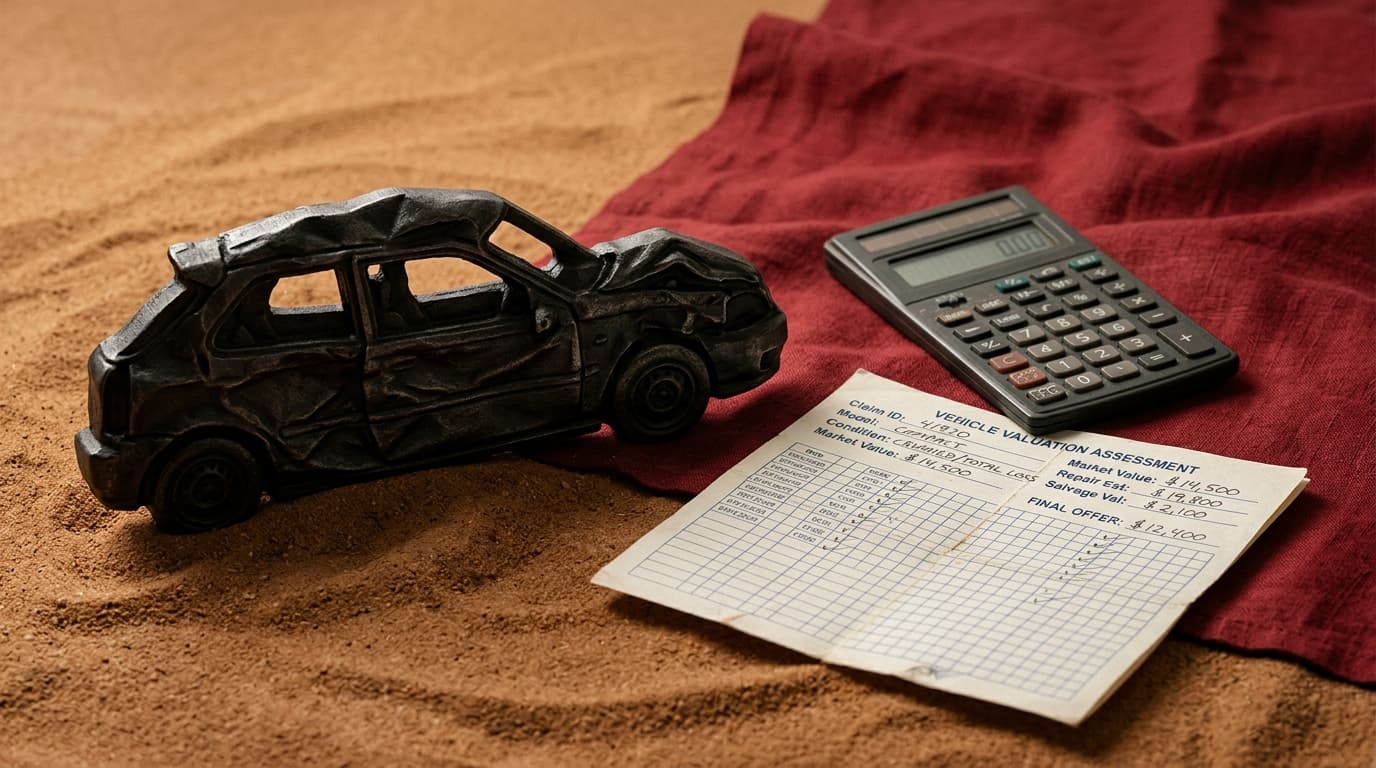
A total loss is not settled at what your car is worth. It is settled at the value written into your policy, minus the deductible, sometimes minus the wreck. On a three-year-old VW Golf 1.5 TSI bought at a 31,670 € Belgian list price, two options signed on the same day with the same insurer produce a 5,700.60 € gap on the day of the crash. Here is the breakdown, line by line.
When is a car declared a total loss in Belgium?
In two cases, and only one of them is about mechanics.
A technical total loss covers a car that no repair can safely return to the road: twisted chassis, damaged structure, destroyed anchor points. An economic total loss covers something else entirely: a perfectly repairable car whose repair would cost more than it is worth. That second case is by far the more common one, and it grows mechanically with the age of the vehicle, because the value falls while the price of parts and labour climbs. An independent expert appointed by your insurer decides between the two, prices the damage and values the salvage.

The repairability threshold is calculated, not declared
The rule published by Wikifin, the financial education site run by the FSMA (Belgium's financial markets regulator), fits in one subtraction: the car becomes an economic total loss as soon as the repair cost exceeds the difference between the actual value before the accident and the salvage value.
Applied to our reference profile, with an actual value of 18,000 € and salvage priced at 2,200 €, the threshold lands at 15,800 €.
| Repair quote | Threshold (actual value minus salvage) | Verdict |
|---|---|---|
| 9,400 € | 15,800 € | Repair, comfortable margin |
| 15,500 € | 15,800 € | Repair, by 300 € |
| 15,800 € | 15,800 € | Exact tipping point |
| 16,100 € | 15,800 € | Economic total loss |
| Twisted chassis | Not applicable | Technical total loss |
Three hundred euros of parts are enough to move a file from the body shop to the scrapyard. That sensitivity explains why two experts can reach opposite verdicts on the same impact: they do not disagree on the principle, they disagree by a few hundred euros on the quote or on the used-car quotation.
Actual value or agreed declining value: which one applies to you?
The answer decides everything else, and it is written in your particular conditions.
Actual value, also called market value, is set on the day of the claim. The expert derives it from age, mileage, general condition and second-hand quotations. It is the value used by the at-fault driver's third-party liability cover, and it is the least generous one in the early years.
Agreed declining value, also called conventional or degressive value, is set when you sign. It starts from the list price or the invoice price, then applies a depreciation grid known in advance and usually annexed to the policy. It falls more slowly than the market, which makes it almost always more favourable while the car is young.
Replacement-as-new value also exists, as an uplifted percentage of the insured sum, up to 125 % with some insurers, reserved for full omnium policies and recent vehicles.
The 1 % monthly depreciation, priced on a 31,670 € Golf
The most common Belgian formula freezes the insured value for 0, 6, 12 or 24 months from first registration, then cuts it by 1 % per month until month 60. The table below applies that grid to our reference profile, list price 31,670 € including VAT.
| Vehicle age | Agreed value, 6-month freeze | Agreed value, 24-month freeze | Gap |
|---|---|---|---|
| 6 months | 31,670.00 € | 31,670.00 € | 0 € |
| 12 months | 29,769.80 € | 31,670.00 € | 1,900.20 € |
| 24 months | 25,969.40 € | 31,670.00 € | 5,700.60 € |
| 36 months | 22,169.00 € | 27,869.60 € | 5,700.60 € |
| 48 months | 18,368.60 € | 24,069.20 € | 5,700.60 € |
| 60 months | 14,568.20 € | 20,268.80 € | 5,700.60 € |
Two lessons come out of that grid. First: the gap between the two options caps at 5,700.60 €, which is 18 % of the list price, and it locks at that figure from year two. The second is less visible. At 36 months, the agreed value under a 6-month freeze reads 22,169 € while the used-car quotation for a petrol hatchback of that age sits closer to 17,400 to 19,000 € on the Belgian market. Even the least generous option pays roughly 4,169 € more than market value.
Beyond month 60 the depreciation schedule stops and most policies revert to actual value. That is the point where omnium cover gradually stops paying for itself, an arbitrage covered in our mini omnium or full omnium comparison.

What does the 24-month freeze option cost?
Do the arithmetic rather than trusting instinct. The option pays a maximum of 5,700.60 €, once, and only if a total loss actually happens. At a premium supplement of roughly 40 € per year, it costs 200 € over five years.
The break-even reads directly: 200 divided by 5,700.60 gives 3.51 %. The option is worth buying as soon as your probability of a total loss over five years exceeds 3.51 %.
What is left after the deductible and the salvage?
The agreed value is not the amount of the bank transfer. Two more lines apply.
| Breakdown line | You hand over the salvage | You keep the salvage |
|---|---|---|
| Agreed value at 36 months | 22,169.00 € | 22,169.00 € |
| Salvage value deducted | 0.00 € | 2,200.00 € |
| Fixed deductible | 500.00 € | 500.00 € |
| Net transfer | 21,669.00 € | 19,469.00 € |
Under omnium cover, the insurer usually asks you to give up the wreck: it resells it for its own account and nothing is deducted. Keeping the wreck therefore costs you its buy-back value, 2,200 € here, which only makes sense if you can extract more from it in parts or use. As for the deductible, it applies to a total loss exactly as it would to a broken mirror; all three possible mechanisms are set out in our guide to the car insurance deductible.
Without omnium cover, third-party liability pays less
With third-party liability only, everything depends on someone else being held liable. Settlement then often runs through the RDR convention, an agreement between Belgian insurers that speeds up payment provided liability is established at 100 %; P&V notes that the mechanism covers files up to 25,000 €.
The main item is then the replacement value, meaning the actual value and not the agreed declining value. On top come the registration tax, towing, storage, administrative fees, a new number plate and a loss-of-use allowance of roughly 20 € per day. Over twenty-one days off the road, that allowance amounts to 420 €.
The total comes to about 18,400 € excluding registration tax, against 21,669 € net under omnium. Roughly 3,250 € of difference, and that ignores the delay: the omnium route pays without waiting for liability to be settled, the liability route waits. And if nobody is at fault, aquaplaning on a motorway for instance, the liability route pays nothing at all.
Which documents does the expert need?
Files rarely stall on substance. They stall on a missing document. Have ready:
- the purchase invoice, the only proof of invoice value if your policy is built on it;
- the vehicle documents: registration certificate, certificate of conformity, latest roadworthiness test;
- a VAT declaration, which determines whether the tax is reimbursed to you;
- every key, spares included, plus alarm and immobiliser codes;
- the service book, which weighs directly on the actual value estimate;
- your bank details and, if you give up the wreck, the written waiver.
Where to check those three lines before signing
No two Belgian insurers use the same grid. AG Insurance, Ethias, AXA, Belfius Insurance, KBC, P&V, Yuzzu, Baloise, Allianz and Federale offer freeze durations, depreciation rates and replacement-as-new caps that diverge sharply behind apparently identical cover. The insurer-by-insurer detail is in our ranking of the best car insurers, the formulas line up on the comparison tool, and a premium simulation prices the effect of the valuation method on your contribution. For the claim procedure itself, our guide to reporting a car insurance claim covers deadlines and forms.
Method and sources
Site reference profile: 35-year-old driver, VW Golf 1.5 TSI, Flemish Brabant, no claims for five years, around 15,000 km a year. List price used: 31,670 € including VAT, Belgian price recorded on 31 August 2026 from the catalogue published by Moniteur Automobile. Agreed values are calculated in-house by applying the standard depreciation grid described above (freeze, then 1 % per month from month 7 to month 60).
The 18,000 € actual value at 36 months is an unattributed market range (17,400 to 19,000 € for a petrol hatchback of that age in Belgium), taken at mid-range for want of a free public quotation service: it serves as a scale, not as a contractual reference. The same applies to the 2,200 € salvage figure, roughly 12 % of actual value, and to the 40 € per year premium supplement for the freeze option. The ratios and gaps remain transposable, since the depreciation applies proportionally.
Valuation rules and the economic write-off threshold come from Wikifin, an initiative of the FSMA, updated 8 June 2026 and consulted on 31 August 2026. The 25,000 € RDR ceiling, the loss-of-use allowance of about 20 € per day and the list of documents for the expert come from the public dossier published by P&V, consulted on 31 August 2026. The contractual framework is the Belgian Insurance Act of 4 April 2014.
This site compares and calculates. It sells no insurance, is not an intermediary under Belgian regulation and issues no individual recommendation: for advice on your own situation, speak to your insurer or to a broker registered with the FSMA. If you disagree with a settlement, the Insurance Ombudsman handles disputes free of charge, and the Tariffication Bureau remains the fallback for drivers refused third-party cover. No insurer pays to appear in this article and no link on this page is affiliated.
In short
A total loss turns on three figures written into your policy long before the accident. The valuation method first: 22,169 € agreed value against 18,000 € actual value on a three-year-old Golf, a 4,169 € gap. The freeze duration next: 5,700.60 € separate a 6-month freeze from a 24-month freeze, for an option that pays off above 3.51 % of five-year risk. The deductible and the salvage last, which turn 22,169 € into 19,469 € in the least favourable case. The tipping point towards the scrapyard is itself one subtraction: repair cost against actual value minus salvage, so 15,800 € in our example. Run a premium simulation varying the valuation method, and the full ranking gives you the grids insurer by insurer.
Garanties & formules comparator
Compare all garanties & formules side by side.
Compare now →
Frequently asked questions
Damien décortique le marché belge de l'assurance auto depuis plus de dix ans. Ancien gestionnaire de sinistres en compagnie, devenu analyste indépendant, il lit les conditions générales ligne par ligne, compare les primes réelles de AG, Ethias, KBC, Belfius, P&V ou Corona Direct, et teste les simulateurs du marché. Sa conviction : beaucoup de Belges surpaient leur prime ou découvrent une exclusion le jour du sinistre, faute d'avoir comparé les garanties. Sur ce site, il traduit le jargon des contrats (RC, omnium, franchise, bonus-malus) en conseils concrets, chiffrés et sans lien commercial caché.