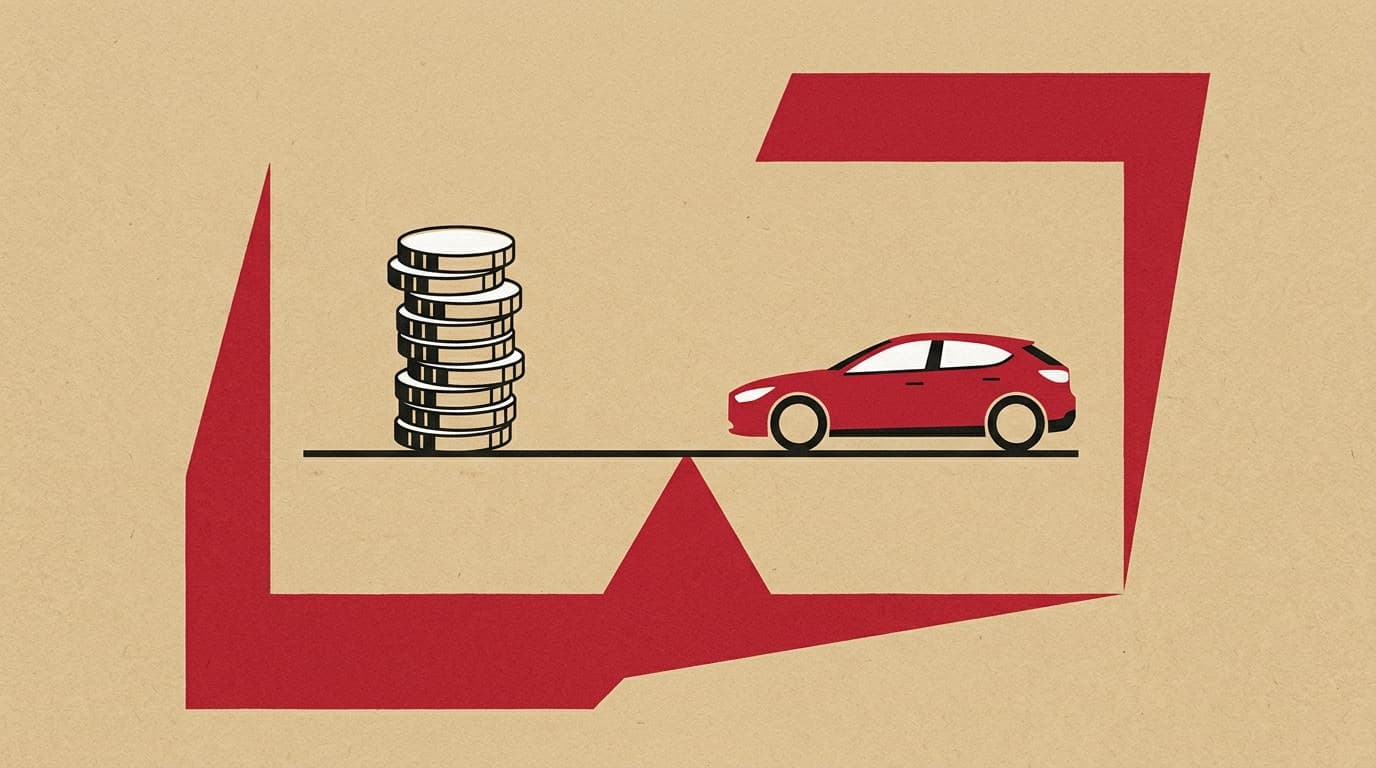
The deductible is the share of a claim that stays in your pocket: the insurer subtracts it before reimbursing you. It concerns almost exclusively omnium — damage to your own car — and rarely civil liability. Behind this simple word hide three very different mechanisms, a direct slider on your premium price, and a few discreet clauses that decide, on the day of a knock, who pays what.
What is a deductible in car insurance?
The deductible is the amount that stays on you at each claim: the insurer subtracts this share before reimbursing you. If a loss costs €1,500 and your deductible is €500, the company pays €1,000 and you settle the remaining €500. It is your share of the risk, set at signing and written into your particular terms.
Its role is twofold. It makes the driver accountable, giving them an interest in avoiding small claims since they bear part of them, and it eases the insurer's work on micro-damage. In return, it gives you a lever on price: the more of it you accept, the less premium you pay.
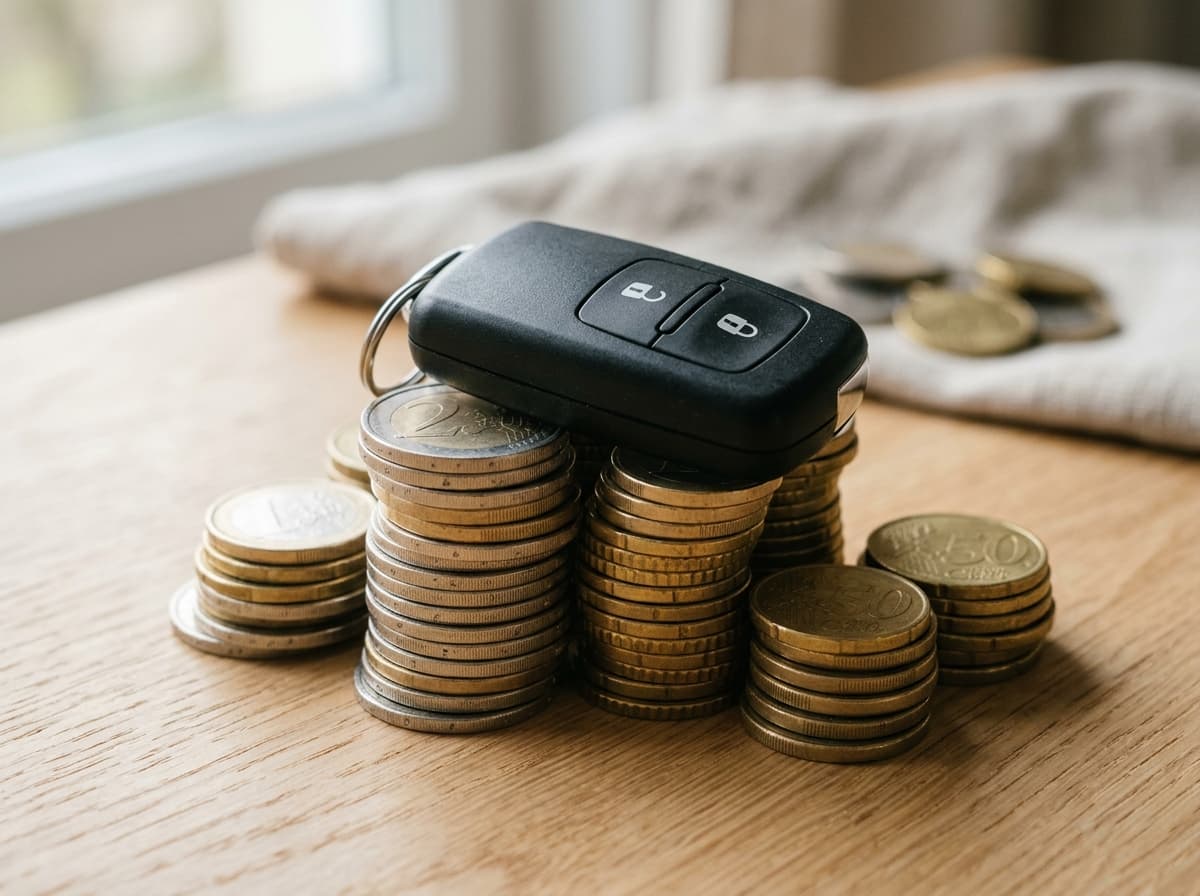
Which cover does the deductible apply to?
The deductible applies above all to omnium, that is to the cover protecting your own vehicle. In full omnium, it typically bears on the "material damage" cover: the damage you cause to your own car, an accident for which you are responsible, or vandalism. That is where the deductible really weighs in a statement.
Mandatory civil liability, on the other hand, settles with no deductible for the vast majority of drivers. It compensates third parties, not your car, and the state made it the minimum floor of every contract. Understanding this boundary avoids much confusion: when people talk about a "car insurance deductible", they almost always mean omnium.
What are the types of deductible in Belgium?
There are three forms of deductible, and they do not behave the same way at all. The table below sums them up before we detail the trickiest one.
| Type of deductible | How it is calculated | Example on a €600 loss |
|---|---|---|
| Fixed amount | Lump sum per claim, often €250 to €1,000 (≈ €500) | You pay €500, the insurer €100 |
| Percentage | 2.5 to 3% of insured value, often capped (€900–1,300) | On a value of €20,000, deductible of €500: same |
| English deductible | Trigger threshold, not a deducted share | Below the €500 threshold? No: €600 > €500, the insurer pays all |
The fixed amount is the most legible: one sum, the same at each claim. The percentage indexes the deductible on the vehicle's value — logical for an expensive car, but often capped so it does not become prohibitive. The English deductible deserves its own section.
How does the English deductible work?
The English deductible is a threshold, not a retained share: it is all-or-nothing. As long as the loss stays below the agreed threshold, the insurer does not step in and you pay in full. As soon as the loss exceeds that threshold, the insurer reimburses the whole, deducting nothing.
In practice, with an English deductible of €500: a bumper at €480 is entirely on you, but the same knock priced at €520 is fully reimbursed. Some insurers offer it as an alternative to the classic lump sum — either a fixed deductible of €500, or an English deductible at €0 beyond €500 of damage.
Is there a deductible in mini-omnium?
Generally, no: mini-omnium most often works without a deductible, because it covers external risks — theft, fire, natural disasters, glass breakage, collision with an animal — and not the damage you cause to your own car. This is one reason it appeals to drivers of cars a few years old.
Two exceptions deserve an eye. A handful of insurers apply a deductible on the theft cover, and a glass-breakage deductible may activate if the repair is not carried out at an approved repairer. By contrast, fire and natural disasters never carry a deductible. To arbitrate between the two formulas, our guide on mini-omnium or full omnium details what each really covers.
How does the deductible influence your premium?
Mechanically: the higher the deductible, the lower the premium. By agreeing to bear a larger share of the risk, you transfer less charge to the insurer, who rewards you with a lower contribution. Conversely, a low or zero deductible protects you better on the day of a claim, but inflates the annual premium.
It is therefore a slider between two expenses: what you pay each year, come what may, and what you pay occasionally when a claim occurs.
Should you choose a high or a low deductible?
It is a calculation rather than a guess. A high deductible pays off if you drive little, declare rarely, and can absorb an unexpected expense: you bank the premium saving every year and the risk of paying out the deductible stays low. A low deductible is more rational if you multiply urban journeys, where small knocks are frequent.
Make the comparison over several years: add up the annual premium saving, then set it against the extra deductible you would pay on a likely claim. A careful, high-mileage driver often gains by raising the deductible; an urban profile exposed to parking knocks has an interest in keeping it contained.
How do you reduce or remove your deductible?
Three concrete levers exist. Using a repairer approved by the insurer reduces or even removes the deductible, in particular on glass breakage: it is often the explicit condition for zero deductible. Some contracts include a decreasing deductible, which shrinks and then cancels after one to three claim-free years — a reward for good driving, close in spirit to the bonus-malus.
Finally, you can buy back a lower deductible for a higher premium. Handle with care: if you declare few claims, the annual premium surcharge quickly exceeds the deductible saving. Compare the two costed scenarios before signing.
Where can you compare deductibles across insurers?
The recurring players on the Belgian market — AG Insurance, Ethias, KBC, Belfius Direct (ex-Corona Direct), P&V, Yuzzu and AXA — apply neither the same amounts nor the same deductible mechanisms. At equal cover, one imposes a fixed €500 while another offers an English or a decreasing deductible: the gap changes both your premium and your out-of-pocket share.
The useful reflex: always compare the premium and the deductible side by side, never the premium alone. The insurer-by-insurer detail is in our ranking of the best car insurers, the offers line up on the comparator, and a premium simulation shows you the direct effect of the deductible level on your contribution.
Method and sources
The amounts, percentages and mechanisms cited are orders of magnitude observed on the Belgian market; they do not replace your contract's particular terms or a personalised quote, which depends on your vehicle, your profile and your postcode. The definitions and the per-cover rules draw on the information published by Test-Achats, the financial education body Wikifin (FSMA) and the Belgian insurers themselves, notably P&V and Yuzzu. No insurer pays to appear in this article, and no link on this page is an affiliate link: we cite, we do not sell.
In summary
The deductible is the first slice of the loss you keep on yourself: it targets omnium, almost never civil liability. It takes three forms — fixed amount, percentage of value, or all-or-nothing English deductible — and acts as a slider on your premium: the higher it is, the less you pay each year, but the more you pay out on the day of a claim. Set it according to your cash flow, reduce it via an approved repairer or a decreasing deductible, and compare it as a criterion in its own right. Run a premium simulation while varying the deductible, and the full ranking will give you the insurer-by-insurer detail.
Prix & primes comparator
Compare all prix & primes side by side.
Compare now →
Frequently asked questions
Damien décortique le marché belge de l'assurance auto depuis plus de dix ans. Ancien gestionnaire de sinistres en compagnie, devenu analyste indépendant, il lit les conditions générales ligne par ligne, compare les primes réelles de AG, Ethias, KBC, Belfius, P&V ou Corona Direct, et teste les simulateurs du marché. Sa conviction : beaucoup de Belges surpaient leur prime ou découvrent une exclusion le jour du sinistre, faute d'avoir comparé les garanties. Sur ce site, il traduit le jargon des contrats (RC, omnium, franchise, bonus-malus) en conseils concrets, chiffrés et sans lien commercial caché.