
Between a mini-omnium and a full omnium, only one difference truly counts: when you cause the accident, the full omnium repairs your car and the mini-omnium does not. Everything else — theft, fire, glass, hail — appears in both. And that single difference costs on average 15 to 30% more premium. So the question is not "which one is better", but "when is that particular cover worth its price".
What is the difference between a mini-omnium and a full omnium?
The full omnium covers damage to your own vehicle when the accident is your fault; the mini-omnium stops just short of that. That is the fault line, and it fits in one sentence.
The mini-omnium — also called partial omnium or small omnium — adds a block of cover that is standard on the Belgian market to mandatory third-party liability: theft, fire, glass breakage and natural forces (hail, storm, falling trees, flooding). Those four have one thing in common: they are events that land on you with no driver at fault.
The full omnium takes that block and adds material damage cover: the bumper against the car-park pillar, the crumpled wing in the roundabout where you misjudged the right of way, the ditch on a rainy evening. Nobody to hand the bill to — except your insurer, if you have the cover.
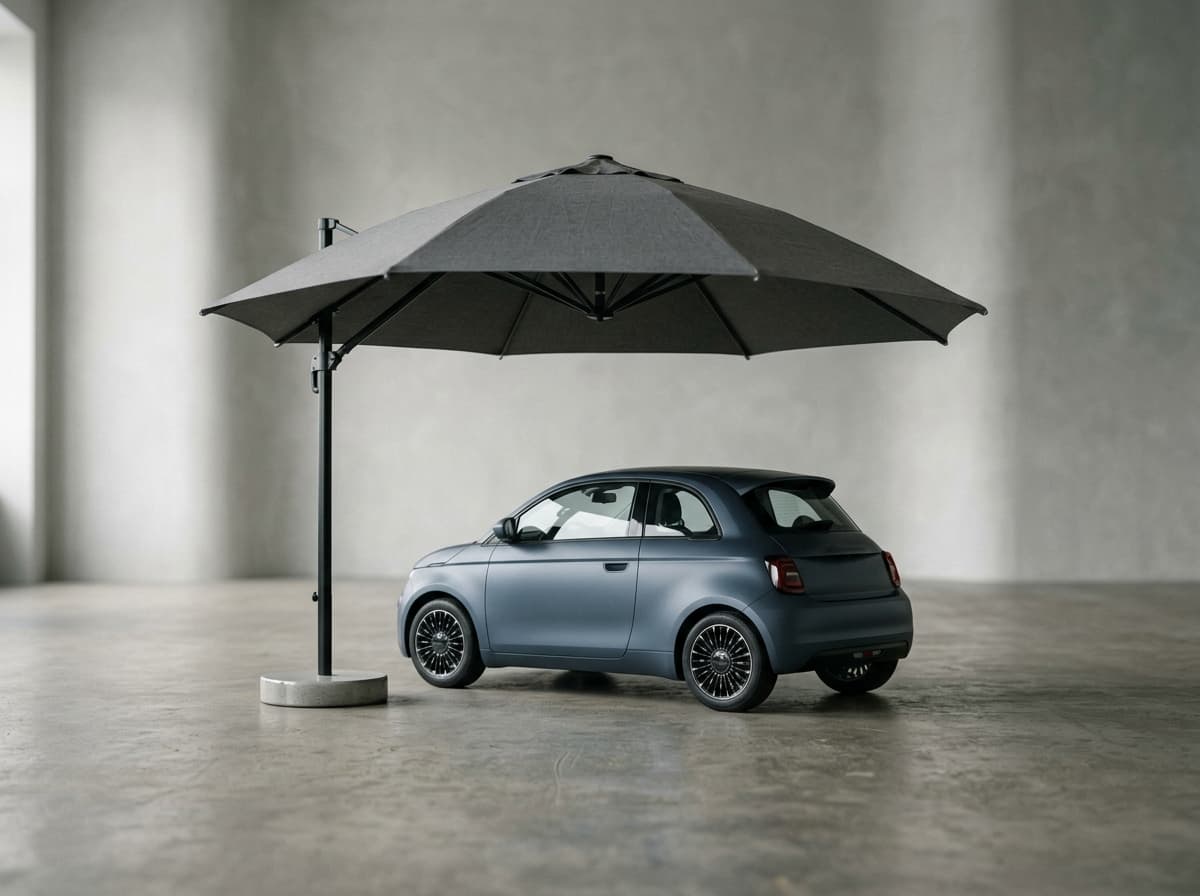
A useful reminder: liability-only cover never protects your vehicle. It pays for damage you cause to others. A liability-only driver who folds his own car against a wall pays everything, in full. That is where the reasoning starts.
What exactly does a mini-omnium cover in Belgium?
The standard base is theft, fire, glass breakage, natural forces — and almost always assistance as an option. But the word "standard" deserves a caveat, because the perimeters diverge at the margins, and the margins are where the bad surprises live.
| Cover | Mini-omnium | Full omnium |
|---|---|---|
| Damage caused to third parties (liability) | Yes | Yes |
| Theft and attempted theft | Yes | Yes |
| Fire, explosion | Yes | Yes |
| Glass breakage | Yes | Yes |
| Natural forces (hail, storm, flooding) | Yes | Yes |
| Collision with an animal | Often, check | Often, check |
| Vandalism | Depends on contract | Depends on contract |
| At-fault material damage | No | Yes |
| Total loss after an at-fault accident | No | Yes |
Three lines of that table are grey and it is not an oversight. Collision with an animal is frequently included in Belgian mini-omniums, but not everywhere, and sometimes under a separate cover billed on top. Vandalism is the champion of divergence: a scratch in the car park, a torn-off mirror — one insurer covers it, another excludes it. And glass breakage hides a cap or a mandatory approved-repairer clause at several players.
How much does a mini-omnium cost compared with a full omnium?
A mini-omnium costs on average 15 to 30% less than a full omnium, with premiums observed on the Belgian market mostly between €410 and €670 a year. Put that way, the gap looks modest. Measured against the value of an old car, it is not modest at all.
Take a concrete case. A used saloon valued at €7,000. The full omnium is quoted at €780 a year, the mini-omnium at €560. The annual gap is €220. Over four years, that is €880 paid for material damage cover — on a vehicle whose insured value, depreciation included, will have fallen well below €5,000 by then. You paid nearly a fifth of the car to cover the risk of damaging it yourself.
In practice, for an average driver: it is not the premium you should look at, it is the ratio between the premium and what the insurer will actually pay back.
What rule decides between the two?
As soon as the annual full-omnium premium exceeds 5 to 7% of the vehicle's current value, step down to a mini-omnium. That is the rule I have applied for years and it holds up well against real files.
The logic is arithmetic, not ideological. Material damage cover can never return more than the vehicle's value, and it returns it reduced by the excess and by depreciation. When the premium approaches a tenth of that ceiling, the expected gain collapses: every year you are funding a tenth of an asset you will only touch in an at-fault claim, excess deducted.
| Vehicle value | 5-7% threshold | Reading |
|---|---|---|
| €25,000 (new) | €1,250 – €1,750 | Full omnium almost always justified |
| €15,000 (2-3 years) | €750 – €1,050 | Full omnium generally worth it |
| €8,000 (5-7 years) | €400 – €560 | Tipping zone: calculate case by case |
| €5,000 (8-10 years) | €250 – €350 | Mini-omnium nearly always more rational |
| €3,000 and under | €150 – €210 | Liability + mini-omnium, or liability only |
The tipping zone around €8,000 is where the reasoning has to become personal: your ability to absorb a dead loss, your mileage, your claims history.
When should you keep a full omnium anyway?
Three situations overturn the 5-7% rule, and they all share the same structure: you owe money, or you cannot absorb the loss.
A vehicle on credit or lease. As long as the financing runs, an uncovered total loss leaves you with the instalments and no car. The value calculation no longer applies: what you are insuring is not the car, it is your debt. Most leasing or renting contracts require a full omnium by clause anyway.
A new or nearly new car. In the first months, the insured value is high, depreciation has not yet bitten, and the premium-to-value ratio is frankly favourable. That is when a full omnium delivers most.
An inability to absorb the loss. If losing €8,000 overnight would derail your budget, the expected-value calculation is no longer enough. Insurance exists precisely to convert a ruinous risk into a predictable expense. That is a personal trade-off, not a reasoning error.
How does depreciation melt your payout?
Depreciation cuts the insured value by roughly 1% a month after a grace period, and it is the most underrated mechanism in the Belgian omnium. The vehicle starts at 100% of the value set in the contract, then that value walks down, month after month, to a floor.
The scales diverge, and that is where comparison gets interesting. A "6 months without depreciation" formula means the value only starts falling by 1% a month from the 7th month after the start date. Some contracts combine two conditions: a 100% payout for the first 6 months and the first 10,000 km, with depreciation then applying only to vehicles over six months old. Others spread the descent out until the vehicle turns 5.
On a car insured for €20,000, a scale that protects for 6 months then drops 1% a month leaves an insured value around €14,000 at three years. A scale that bites from month one leaves you lower still. At identical premiums, that is thousands of euros of difference on the day of a total loss — and none of it shows up in the advertised price.
Agreed value or actual value: what changes?
Agreed value is fixed in advance in the contract; actual value is assessed after the claim by an expert. The first removes the negotiation; the second opens it at the worst possible moment.
Under agreed value (also called conventional value), the insured amount is set in black and white when you subscribe, depreciation deducted according to the agreed scale. You know in advance what your contract is worth. Under actual value, the insurer has the vehicle valued at the claim date according to its rating on the used market — and you did not choose that rating.
For an ordinary car, the gap is often small. For a well-maintained vehicle, a low-mileage one, or one with options that do not show up in a standard rating, agreed value protects noticeably better. It is a point to settle when you subscribe, never afterwards.

How should you read the excess before signing?
An excess advertised at "0%" is almost never an absence of excess: very often it is an English excess, and the mechanism is radically different.
A classic excess is always deducted from the payout: €1,500 of damage, €350 excess, the insurer pays €1,150. Simple and linear.
An English excess works on an all-or-nothing basis around an intervention threshold — a fixed amount, or often around 2.5% of the insured value. Below the threshold, the insurer pays nothing. Above it, the insurer covers everything, deducting nothing. On €10,000 insured, the threshold is about €250: a €200 repair is entirely yours, a €450 repair is entirely the insurer's.
It is neither a trap nor a gift, it is a trade-off. An English excess is excellent on medium and heavy claims, poor on small car-park knocks. The mistake is believing you bought "zero excess" and discovering the threshold in front of a €240 body-shop quote.
Which Belgian insurers should you compare on these formulas?
The players that come up consistently on omniums in Belgium are AG Insurance, Ethias, KBC, Belfius Direct (ex-Corona Direct), P&V, Yuzzu and AXA. None is structurally cheapest: the gaps come from depreciation scales, the mini-omnium perimeter and the type of excess — three parameters that do not appear on a price table.
The useful reflex: ask every insurer for the same three pieces of information in writing. The exact depreciation scale. The type of excess (classic or English) and its threshold. The precise mini-omnium perimeter on vandalism and animal collision. Three answers, three table rows, and the ranking often shifts compared with price alone.
The criterion-by-criterion detail is in our ranking of the best car insurers, and the formulas go side by side on the comparator.
Method and sources
The ranges quoted are orders of magnitude taken in July 2026 from the public offers and market comparisons of Belgian insurers; they do not replace a personalised quote, which depends on your vehicle, your postcode and your record. The payout, depreciation and agreed-value mechanisms draw on the explanations published by Wikifin, the FSMA's financial education body, as well as by Belgian insurers themselves, notably P&V and AG Insurance. No insurer pays to appear in this article, and no link on this page is an affiliate link: we cite, we do not sell.
In summary
A mini-omnium and a full omnium are not two contract qualities, they are two perimeters. The only real dividing line is material damage cover, and its price is judged on a ratio: 5 to 7% of the vehicle's value, no more. Read the depreciation scale before the premium, the type of excess before the discount, and the exact mini-omnium perimeter before assuming it is standard. Compare the cover, not just the price — the "cover" column is the one that decides on the day of the claim. Run a premium simulation on both scenarios, and the full ranking will give you the insurer-by-insurer detail.
Garanties & formules comparator
Compare all garanties & formules side by side.
Compare now →
Frequently asked questions
Damien décortique le marché belge de l'assurance auto depuis plus de dix ans. Ancien gestionnaire de sinistres en compagnie, devenu analyste indépendant, il lit les conditions générales ligne par ligne, compare les primes réelles de AG, Ethias, KBC, Belfius, P&V ou Corona Direct, et teste les simulateurs du marché. Sa conviction : beaucoup de Belges surpaient leur prime ou découvrent une exclusion le jour du sinistre, faute d'avoir comparé les garanties. Sur ce site, il traduit le jargon des contrats (RC, omnium, franchise, bonus-malus) en conseils concrets, chiffrés et sans lien commercial caché.