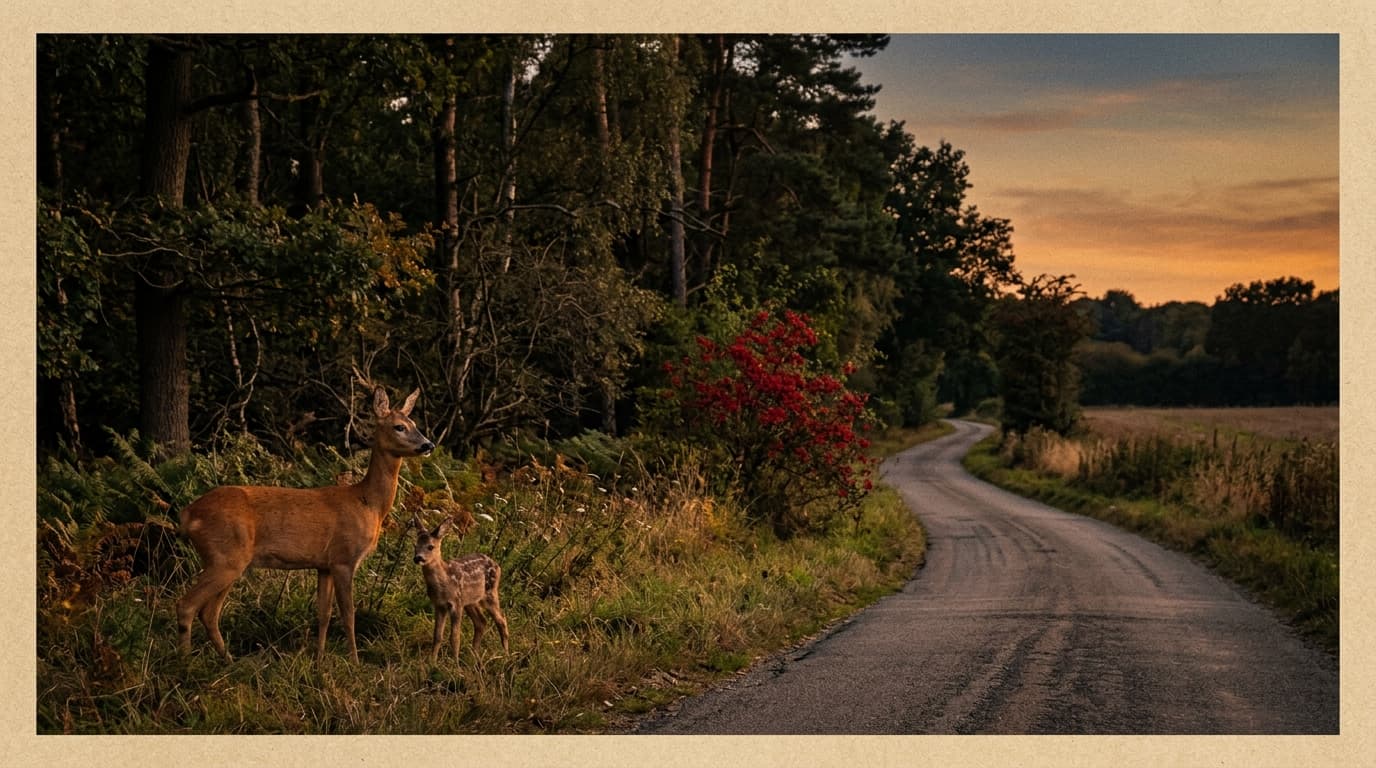
Yes, if your contract includes mini omnium or full omnium: hitting a wild boar or a deer then falls under the animal collision cover, usually with no deductible and no effect on your bonus-malus. With third party liability alone, the repair stays with you. On the best documented Belgian case that is 2,300 €, or 6.5 years of third party premium.
A few Belgian terms for readers new to the market. Omnium is the Belgian name for comprehensive cover: mini omnium covers external risks such as theft, fire, glass, natural forces and animal collision, full omnium adds damage to your own car when you are at fault. The bonus-malus is a 0-22 scale on which each at fault claim moves you up and each claim free year moves you down, with a direct effect on your premium. The FSMA is the Belgian financial services and markets authority, which licenses insurers and brokers.
Does insurance cover an accident with a wild boar?
It depends on two things: the formula, and how the accident happened.
A direct collision with the animal is covered by mini omnium as well as by full omnium. Swerving around it is a different matter. Test-Achats says it bluntly: veering away to spare the animal earns nothing if contact did not happen, unless you can prove rescue costs. Here are the six cases, priced on 2,300 € of damage.
| Situation | Cover that applies | Out of pocket on 2,300 € | Effect on your degree |
|---|---|---|---|
| Hit the animal, third party only | None | 2,300 € | None |
| Hit the animal, mini omnium | Animals or natural forces | 0 € as a rule | None |
| Hit the animal, full omnium at DVV | Natural forces | 0 € | None |
| Animal avoided without contact (tree, ditch), mini omnium | None | 2,300 € | None |
| Same case, full omnium at DVV | Material damage | 400, 600 or 800 € | None |
| Animal avoided, your car hits a third party at fault | Liability for the third party, material damage for you | Deductible, then malus | Plus 5 degrees |
The 2,300 € figure is not an average. It is the damage cited by RTBF on 12 October 2014 for a wild boar collision near Vaux-sur-Sûre, the only priced Belgian bill we found. No Belgian average cost is published: it serves here as a calculation yardstick, nothing more.
What does third party insurance cover after hitting a deer?
Nothing for your car.
Compulsory liability cover pays for what you cause to others. A wild animal has no owner, so nobody to send the bill to. One case remains where a third party repays: the domestic animal, whose owner may be liable, and their family liability cover with them. For a cow that escaped from a field, it is worth asking the police at the scene.
How much does the cover for game collisions cost?
Between 185 and 467 € a year, depending on the mini omnium block you buy. The average of nine insurers is 308 € on our reference profile, the gap between mini omnium (661 €) and third party liability alone (353 €), broken down in our article on the cost of comprehensive cover.
| Option added to third party liability | Annual extra | A 2,300 € claim is worth |
|---|---|---|
| Cheapest mini omnium block (ACM Insurance) | 185 € | 12.4 years of extra premium |
| Average mini omnium block of nine insurers | 308 € | 7.5 years |
| Most expensive mini omnium block (Ethias) | 467 € | 4.9 years |
| Average full omnium (1,135 € minus 353 €) | 782 € | 2.9 years |
A useful reading: for animal risk alone to justify 308 € a year, you would need one claim every 7.5 years on average, a 13.4 % chance each year. Nobody buys this block for wild boar alone, it also covers theft, fire, glass and hail, whose cost is priced in our article on hail damage.

Is there a deductible, and does a malus apply?
The deductible depends on the line under which the insurer files the animal. At DVV, collision with an animal sits in the natural forces cover, in mini omnium as well as in full omnium, with an obligation to file a police report, according to its omnium product sheet. Only the material damage cover of full omnium carries a deductible there: 400 € under a 15,000 € car value, 600 € up to 25,000 €, 800 € above.
The bonus-malus does not move. The 0-22 scale only goes up after an at fault third party liability claim. In our bonus-malus guide, five extra degrees cost 280 € in the first year on a 700 € base premium.
Claim or pay out of pocket: from what damage?
As soon as the repair exceeds the deductible, and with no further calculation when it is zero.
With no third party involved and no malus, claiming costs nothing but your time. The trade off becomes a simple subtraction: what the insurer pays is the repair minus the deductible. Here is how it works out on an avoided animal with full omnium at DVV.
| Repair | Deductible 400 € | Deductible 600 € | Deductible 800 € |
|---|---|---|---|
| 500 € | 100 € paid | 0 € | 0 € |
| 1,000 € | 600 € paid | 400 € | 200 € |
| 2,300 € | 1,900 € paid | 1,700 € | 1,500 € |
| 4,000 € | 3,600 € paid | 3,400 € | 3,200 € |
Below the deductible, paying yourself is the only choice. Above it, claiming pays, unless a third party is hit: the 5 degree rise is then worked out over five years, as in our article on reporting a claim or paying out of pocket.
Six steps in the 48 hours after the collision
- Secure the area: hazard lights, warning triangle, high visibility vest. That is the instruction of the federal police.
- Call the police. They draw up the report your insurer will ask for.
- Photograph the damage, the place, the animal and any blood traces, and note the time, GPS coordinates and witnesses.
- If the animal is injured, the police will give you the ranger of the Department of Nature and Forests to contact.
- Notify your insurer or broker without delay, within 48 hours to be safe.
- Repair nothing before the expert has visited.
Four lines of your contract to reread before autumn
- Direct or indirect damage: Test-Achats notes that most insurers only pay for the impact itself, while AG Insurance, Allianz, Argenta, AXA, Baloise, Belfius, CBC, P&V and Vivium also cover indirect damage, such as the tree hit after the collision. Analysis of January 2018, published on 11 January 2021: check against your current contract.
- Animals covered: large game and livestock only, or any animal.
- Deductible on the animals line: zero, or that of material damage.
- Proof required: police report and reporting deadline.

Method, profile and sources
Reference profile: a 35 year old driver, VW Golf 1.5 TSI, Flemish Brabant, no claims for five years, around 15,000 km a year. Third party liability (353 €), mini omnium (661 €), full omnium (1,135 €) and mini omnium blocks (185 to 467 €): our own averages on the public grids of Mon-Assurance-Auto (Yago S.A., broker licensed by the FSMA under number 114863) recorded on 26/01/2026, whose simulated profile differs from ours, so only gaps and ratios are claimed to be transposable. Damage of 2,300 €: RTBF, 12/10/2014, a single case, not an average. Deductibles of 400, 600 and 800 € and animal cover: DVV omnium product sheet, consulted on 29/09/2026. Animals covered, indirect damage and swerving: Test-Achats, published on 11/01/2021, analysis of contracts of January 2018. Steps to take and the 48 hour deadline: federal police, consulted on 29/09/2026. The calculations (years of extra premium, yearly chances, payouts) are our own divisions and subtractions. Conditions differ between insurers: your contract remains the reference.
This site compares and calculates, without selling insurance or acting as an intermediary within the meaning of the Insurance Act of 4 April 2014: to change your cover, speak to your insurer or a broker licensed by the FSMA. In case of a dispute over a refusal, the Insurance Ombudsman steps in free of charge, and the Assuralia federation publishes sector benchmarks. For the full procedure after a claim, see our guide to reporting a car insurance claim; to compare formulas, our article mini omnium or full omnium, the comparison tool and our ranking of the best car insurers. No link is affiliated.
Simulateur & devis comparator
Compare all simulateur & devis side by side.
Compare now →
Frequently asked questions
Damien décortique le marché belge de l'assurance auto depuis plus de dix ans. Ancien gestionnaire de sinistres en compagnie, devenu analyste indépendant, il lit les conditions générales ligne par ligne, compare les primes réelles de AG, Ethias, KBC, Belfius, P&V ou Corona Direct, et teste les simulateurs du marché. Sa conviction : beaucoup de Belges surpaient leur prime ou découvrent une exclusion le jour du sinistre, faute d'avoir comparé les garanties. Sur ce site, il traduit le jargon des contrats (RC, omnium, franchise, bonus-malus) en conseils concrets, chiffrés et sans lien commercial caché.