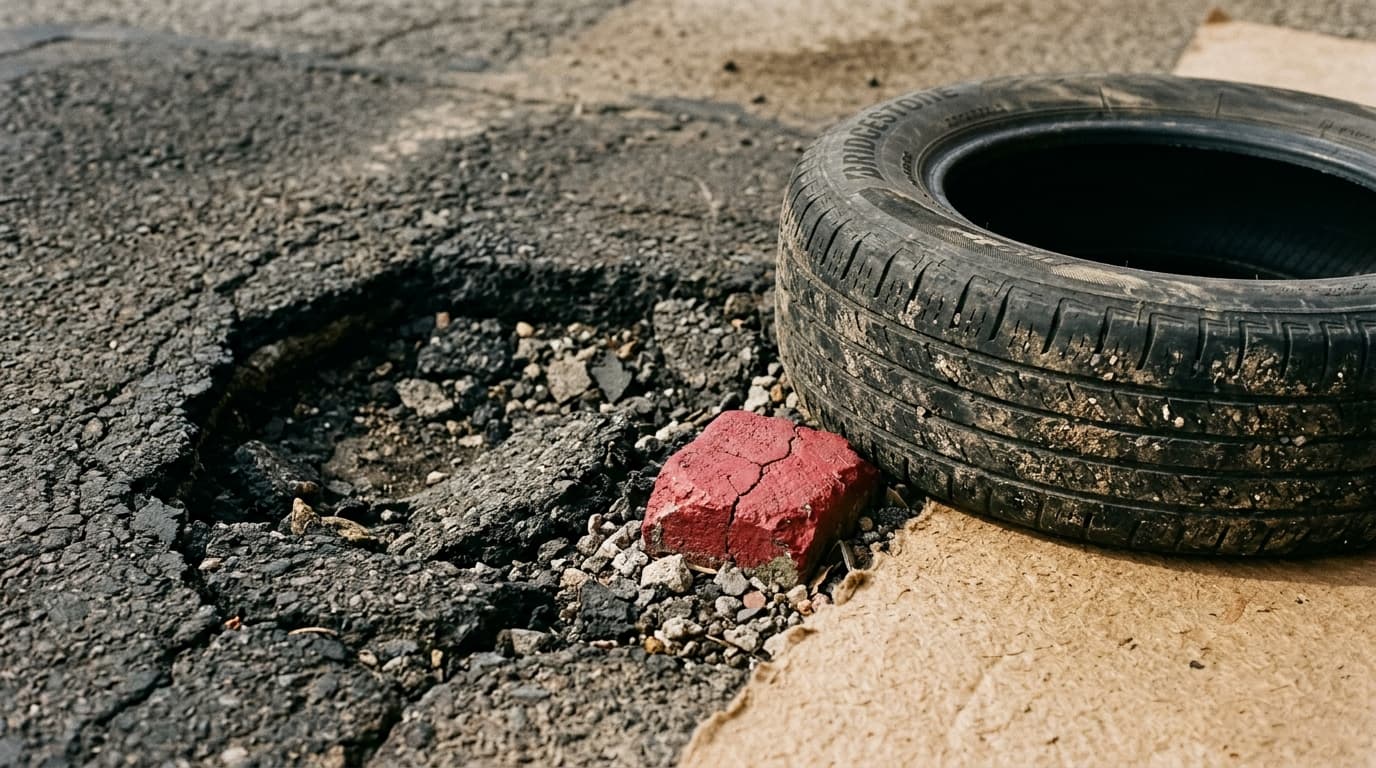
A pothole damages your car: in principle only a full omnium (the Belgian comprehensive cover) pays, and only above the deductible. On our reference profile that deductible is €791.75, and three damage cases out of four stay below it. The one that exceeds it can cost more in malus than it returns.
Who answers for a pothole: your insurer or the road manager?
Both, through two circuits that look nothing alike. Your insurer compensates you under your contract. The road manager (the Region, the province or the municipality) answers for the state of the road, but only if you can show the hole caused the damage.
The first circuit is fast, capped by the deductible and billed through your premium. The second is slow, free in Wallonia, and never touches your contract. Neither rules out the other, with one rule to remember: no double compensation.
Which cover pays for pothole damage?
Only one really does: the full omnium, through its material damage cover. Civil liability repairs other people's property, never your own car. The mini-omnium (theft, fire, glass breakage, natural forces) is not aimed at this kind of impact.
| Cover | Pothole damage to your own car | Note |
|---|---|---|
| Civil liability only | No | No injured third party |
| Mini-omnium | No, in principle | No theft, fire or glass breakage, unless the impact cracks the windscreen |
| Full omnium | Yes, above the deductible | Tyre-only damage often excluded |
The last line is the costly one. Test-Achats points out that most omnium policies do not step in when only the tyre is hit, which removes the most frequent damage from the game.
How much does pothole damage cost on the reference profile?
From €115 to more than €1,500, depending on whether the impact stops at the tyre or reaches the suspension. The amounts below apply to our profile: a 35-year-old driver, VW Golf 1.5 TSI, Flemish Brabant, no claim for five years, about 15,000 km a year.
| Scenario | Detail | Total | Below the €791.75 deductible? |
|---|---|---|---|
| A. Tyre only | 1 tyre €95, fitting €20 | €115 | Yes |
| B. Tyre and straightened wheel | €115 + straightening €125 | €240 | Yes |
| C. Tyre and new wheel | €115 + wheel €400 | €515 | Yes |
| D. Running gear | Wishbone, ball joint, alignment (illustrative amount) | €1,500 | No, €708.25 above |
The tyre comes from a range of €87 to €131 for a 205/55 R16 summer tyre (Michelin Primacy 5 up to Continental UltraContact NXT), observed at French retailers on testpneus.fr on 06/10/2026. Straightening at €50 to €200 per wheel and a new wheel at €100 to over €1,000 come from the Mister-Auto blog (22/05/2023). The €20 fitting, the €400 wheel and the €1,500 running gear are unattributed market assumptions: they place the threshold, they do not establish a price list.
Above what amount does the omnium pay off?
As soon as the damage exceeds the deductible plus the premium surcharge the claim triggers. On the profile, the €791.75 deductible equals 2.5% of a €31,670 list value (observed 31/08/2026); the full omnium premium is €1,135 a year (Mon-Assurance-Auto grids, observed 26/01/2026).
The surcharge hinges on something insurers do not publish: the share of the premium subject to a material-damage ladder. We therefore let it vary. The calculation runs at level 11 (85% of the base premium, so 1,135 ÷ 0.85 = €1,335.29), with a five-level malus that fades over five years, using the 23-level reference scale already detailed in our guide on the break-even calculation.
| Assumption | Cumulated surcharge over 5 years | Break-even (deductible + surcharge) |
|---|---|---|
| Ladder on the whole premium | €1,014.82 | €1,806.57 |
| Ladder on half the premium | €507.41 | €1,299.16 |
| No material-damage ladder | €0 | €791.75 |
On scenario D at €1,500, the omnium pays €708.25. With a ladder on half the premium, the net gain is €200.84. With a ladder on the whole premium, it turns into a €306.57 loss. For A, B and C the threshold is never reached: reporting returns nothing.
Does a pothole claim raise your bonus-malus?
Not your civil liability scale. On the material damage cover, it depends on the insurer.
The Belgian 0 to 22 bonus-malus ladder only tracks at-fault civil liability claims, and a pothole is not one. Test-Achats does point out that some insurers apply a similar system to the material damage cover, and that this cover's premium rises when you are the only party involved. The table above frames the effect, from zero to more than a thousand euros.
What are the chances of compensation from the Region or the municipality?
Slim but real, and the entry cost is nil. In Flanders, according to VRT NWS (19/07/2026), the administration received 3,016 claims between 2021 and 2025 and paid out €2,359,231.07, with about one file in three accepted. That works out at €782 per claim filed, all outcomes included. Potholes and subsidence are the leading cause of accepted files. We found no equivalent published figure for Wallonia or Brussels.
In Wallonia, the official page (updated 1 October 2026) requires a direct and certain causal link, prohibits double compensation and announces 6 months to 1 year of processing, free of charge.
Apply that one-in-three rate, as an assumption, to our scenarios: the expected reimbursement is €38 for A, €80 for B, €172 for C and €500 for D. The figure is not a promise, it simply says that a claim is worth an hour of paperwork as soon as the repair passes about a hundred euros.
Should you report to your insurer and claim from the Region at the same time?
Most of the time, no: pay, claim from the road, keep your premium intact. The table follows the four scenarios.
| Case | What to do |
|---|---|
| A, B or C (under €791.75) | Pay yourself, claim from the Region or municipality |
| D (€1,500) and material-damage ladder unknown | Ask the insurer whether a ladder applies before reporting |
| D and insurer without a material-damage ladder | Report: €708.25 net |
| Bodily injury or third party involved | Always report, no calculation |
Notice of the claim is still due within the contract deadline, often eight days, under article 74 of the Act of 4 April 2014. You can notify the insurer and tell it you are asking for nothing. The full mechanics are in our guide on reporting a claim or paying out of pocket, and the step-by-step procedure in reporting a car insurance claim.
Checkpoints to gather on the spot, before you leave the road:
- photos of the hole with a reference object for scale;
- the exact location, and the name of the road manager;
- a police report if possible, and witness contact details;
- the replaced parts, kept, with the garage invoices.
Where should you send the claim in each region?
To the manager of the road concerned, not the one where you live.
| Region | Where to send it | Note |
|---|---|---|
| Flanders | Agentschap Wegen en Verkeer | For regional roads |
| Wallonia | Territorial Direction des Routes | Free number 1718, WalOnMap tool to identify the manager |
| Brussels | Brussels Mobility | For regional roads |
| Municipal road | Municipality, online form | Often on the municipal website |
These bodies come from a Test-Achats dossier of February 2020 and the Walloon page; check them before writing. If the answer is negative, the regional ombudsman or a lawyer remains an option, and the Insurance Ombudsman handles disputes with your own insurer.
Method and sources
Tyre amounts come from testpneus.fr, observed on 06/10/2026 at French retailers; the wheel repair ranges come from the Mister-Auto blog, published 22/05/2023. The €1,135 omnium premium and €791.75 deductible are the site's reference profile, Mon-Assurance-Auto grids observed on 26/01/2026 and a list value observed on 31/08/2026. The Flemish figures come from VRT NWS (19/07/2026) and cover Flanders only; the Walloon procedure comes from wallonie.be (updated 01/10/2026). The road manager's liability, the bodies by region and the exclusion of tyre-only damage rest on Test-Achats (25/02/2020), and the material-damage ladder on its bonus-malus dossier. The duty to notify a claim rests on article 74 of the Act of 4 April 2014. The one-in-three rate is a Flemish figure applied here as an assumption. These benchmarks are neither a quote nor personalised advice: your contract and the FSMA (Belgium's financial regulator) prevail, and the Insurance Ombudsman remains the recourse in case of refusal. No insurer pays to appear in this article, and no link is an affiliate link.
In summary
A pothole is almost always settled at your own expense, then claimed from the road authority. A full omnium pays nothing below €791.75 of damage, and above it the malus of a material-damage ladder can wipe out the gain. Run a premium simulation, compare contracts on the comparator, and find the insurer-by-insurer detail in the ranking of the best car insurances. For other everyday damage, see windscreen breakage and vandalism.


Simulateur & devis comparator
Compare all simulateur & devis side by side.
Compare now →
Frequently asked questions
Damien décortique le marché belge de l'assurance auto depuis plus de dix ans. Ancien gestionnaire de sinistres en compagnie, devenu analyste indépendant, il lit les conditions générales ligne par ligne, compare les primes réelles de AG, Ethias, KBC, Belfius, P&V ou Corona Direct, et teste les simulateurs du marché. Sa conviction : beaucoup de Belges surpaient leur prime ou découvrent une exclusion le jour du sinistre, faute d'avoir comparé les garanties. Sur ce site, il traduit le jargon des contrats (RC, omnium, franchise, bonus-malus) en conseils concrets, chiffrés et sans lien commercial caché.