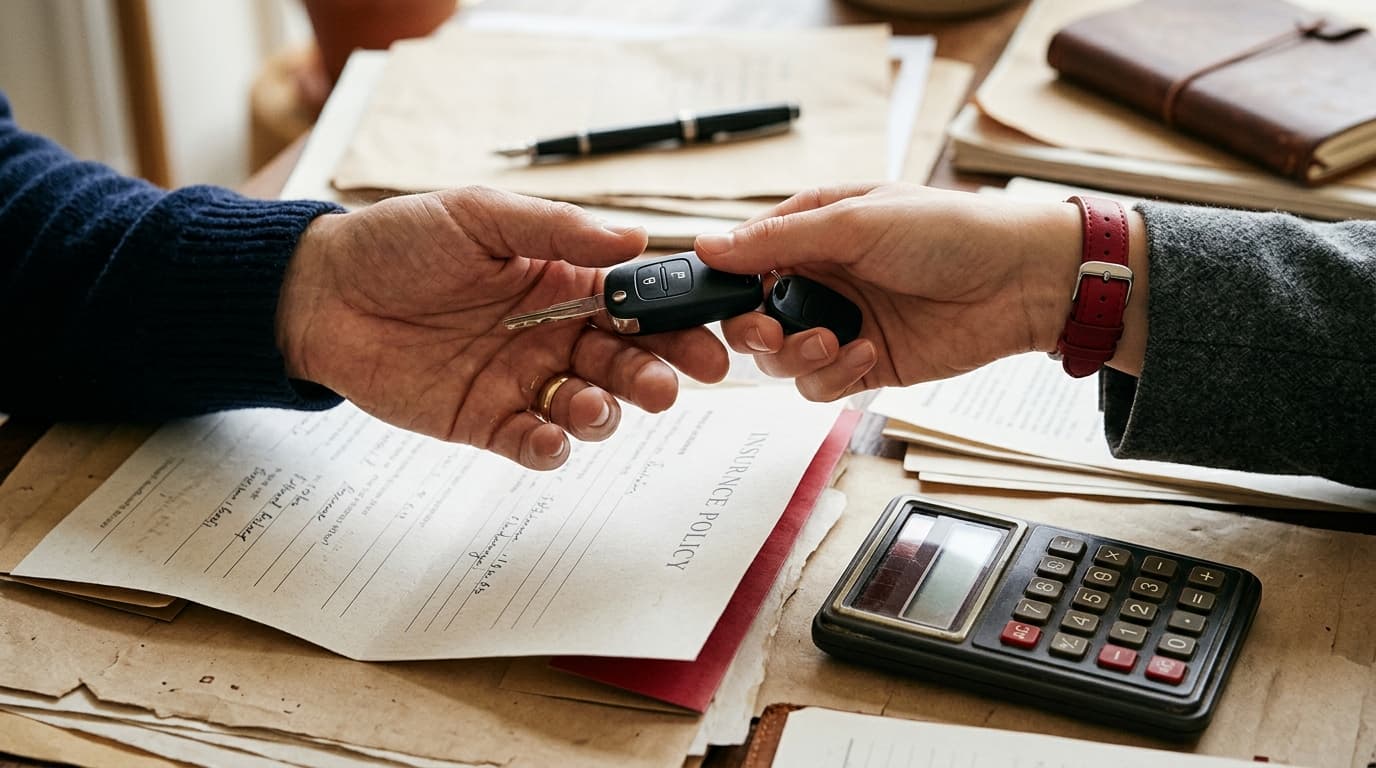
Yes, you can lend your car: your liability cover applies in principle to any driver holding a licence, with no formality for a one-off loan. The price of the loan is settled elsewhere. If the borrower is at fault, your excess and your malus fall on you: €1,035 over five years for our reference profile.
Can you lend your car without telling your insurer?
In principle yes, for an adult with a valid licence and a one-off loan. Test-Achats, the consumer association, says it plainly: compulsory insurance covers the liability of anyone driving your car, as long as they meet the legal conditions and do not drive against your will. The Ethias text relayed by the local police adds a caveat for drivers under 26.
Neither source gives a single amount. Here they are.
| Situation | Tell the insurer? | Left to you |
|---|---|---|
| Friend aged 26 or over, one-off loan | No | Omnium excess (€500) and malus if at fault |
| Child under 26, occasional use | Yes, according to the local police | At Ethias, €800 liability excess if not named |
| Relative who drives every week | Yes, as habitual or occasional driver | Reduced payout if the policy is inaccurate |
| Borrower without a valid licence | Not applicable | Normal cover doubtful, insurer may seek recourse |
| Company car | Read the car policy | Depends on the employer |
Who pays when the borrower is at fault?
Your liability cover compensates the victim, full stop. For your own damage, it all depends on the omnium.
With an omnium, it repairs your car minus the excess, and the borrower owes you that excess. Without one, the borrower must pay, and Test-Achats adds that legal expenses cover does not in principle help if they refuse. On €4,000 of repairs the gap is plain: €500 with an omnium, €4,000 without, eight times more.
How much does the malus cost the owner over five years?
€535 for the liability premium of our reference profile, and up to €808 if you count everything. An at-fault accident by the borrower raises your level by five steps, as if you had driven.
The calculation compares two paths. Our own assumption: the €353 liability premium is paid at level 6, reached after five claim-free years from the starting level 11, that is 66% of a base premium of €534.85. With no accident, the level falls one step a year. With the accident, it jumps by five and then falls one step a year. The scale is the one published by HelloSafe, consulted on 18/10/2026, a reference scale that each insurer has adapted since 2004. Bonus-malus is the Belgian system that raises or lowers your premium according to your at-fault claims history, on a scale from 0 to 22.
| Renewal | Level, no accident | Premium, no accident | Level, with accident | Premium, with accident | Extra cost | Total |
|---|---|---|---|---|---|---|
| 1 | 5 | €336.95 | 11 | €454.62 | €117.67 | €117.67 |
| 2 | 4 | €320.91 | 10 | €433.23 | €112.32 | €229.98 |
| 3 | 3 | €304.86 | 9 | €411.83 | €106.97 | €336.95 |
| 4 | 2 | €288.82 | 8 | €390.44 | €101.62 | €438.58 |
| 5 | 1 | €272.77 | 7 | €369.05 | €96.27 | €534.85 |
| 6 to 11 | 0 | €267.42 | 6 to 1 | €353.00 to €272.77 | €85.58 to €5.35 | €807.62 |
The malus lasts eleven renewals: the claim-free driver would already be at the floor, level 0, while yours is still coming down. This method is longer than the one in our claim-or-pay calculator, which stops when you return to your current level; here we compare with what you would really have paid without the accident.
Add the excess. For an owner who fronts everything: €500 plus €535, so €1,035 over five years and €1,308 to the end. Some contracts apply the scale to the omnium too: on a €1,135 total premium, the same calculation gives €1,720 over five years, or €2,220 with the excess.
Should you name a driver under 26?
It can be priced, and the answer changes with how often the car is lent. The rules below are Ethias's, taken from its excess page (published 09/01/2019) and from the occasional-driver page cited in our article on ways to lower your premium: an €800 liability excess if the young driver is not in the policy, €500 only on weekend nights if they are, and 15% more liability premium if they are named. They do not describe the whole market.
| Option | Certain yearly cost | Liability excess if an accident happens |
|---|---|---|
| Do not name | €0 | €800 |
| Name as occasional driver | €52.95 (15% of €353) | €0, or €500 on weekend nights |
Naming saves €800 if the accident happens: it pays for itself once the yearly probability exceeds 52.95 ÷ 800, that is 6.6%. Assuralia measures 4.90% of liability claims per car in 2023: at that frequency, the expected excess is only €39.20. For a weekend loan, not naming costs less. For a young person who drives every week, the frequency rises and the calculation flips.
When does a relative become a habitual driver?
Nobody publishes the threshold. Test-Achats only says that a regular driver must be reported.
An inaccurate declaration is expensive. Take the €52.95 not paid: the premium paid is 353 ÷ 405.95, so 87% of what was due, and the payout falls by 13%. On €4,000 of damage to your car, you lose €521.74, almost ten times the saving. The law of 4 April 2014 allows this proportional reduction; the real extent depends on the file.
What if the borrowed car is stolen or damaged?
Theft is only reimbursed if your contract includes the theft cover, that is a mini-omnium or a full omnium, with the excess on you. On the reference grid, that block costs €308 a year (€661 minus €353). A three-year-old Golf is worth about €18,000, within a range of €17,400 to €19,000: the block amounts to 1.7% of the car's value.
Two cases cause trouble. If the borrower disappears with the vehicle, the omnium may not apply. And leaving the keys on the dashboard can count as gross negligence.
And when you are the one borrowing?
With an omnium on the car, you only pay the excess. Without one, the owner can claim the entire bill: €4,000 instead of €500.
Five checks before handing over the keys
- The borrower's licence is valid, and so is the car's insurance certificate.
- You know whether you have an omnium, and the exact amount of its excess.
- The keys stay neither on the dashboard nor in the car, even for five minutes.
- You have written in a message, before departure, who pays the excess, the malus and any fines.
- For a company car, the car policy allows lending.
Method, reference profile and sources
The site's reference profile is a 35-year-old driver, VW Golf 1.5 TSI, Flemish Brabant, no claim in five years, about 15,000 km a year. The premiums of €353 (liability), €661 (mini-omnium) and €1,135 (full omnium, liability included) are averages of nine insurers recorded on 26/01/2026 by Mon-Assurance-Auto (Yago S.A., broker approved by the FSMA, the Belgian financial regulator, no. 114863), for a woman born in 1968 at the lowest level, driving an 85 kW diesel Golf in Walloon Brabant, under 10,000 km a year. That profile differs from ours: only gaps and ratios transfer. Level 6, the €500 excess, the €4,000 damage and the €18,000 value are this site's calculation assumptions. The level scale comes from HelloSafe (last modified 20/03/2023). The lending rules come from Test-Achats (published 20/11/2023) and the local police (published 02/05/2023), consulted on 18/10/2026. The €800 and €500 excesses are Ethias's: check your own contract. The Belgian framework is the law of 4 April 2014 on insurance; Wikifin explains the omnium.
This site compares and calculates. It does not sell insurance, is not an intermediary under Belgian law and gives no individual recommendation: for your policy, speak to your insurer or an FSMA-approved broker. In a dispute, the Insurance Ombudsman steps in free of charge. No insurer pays to appear here and no link is an affiliate link.
In summary
Lending your car is covered for liability, not for your wallet. Count a €500 excess and €535 of malus over five years on a €353 liability premium, more if the scale also hits the omnium. For a driver under 26, the calculation favours naming them as soon as they drive every week: the break-even is 6.6%. Write down who pays what before the keys change hands. Run a premium simulation, compare in the comparator and open the ranking of the best car insurers. For a claim that has already happened, the reporting procedure is laid out step by step, and the claims history certificate carries your record forward.

Profils conducteurs comparator
Compare all profils conducteurs side by side.
Compare now →
Frequently asked questions
Damien décortique le marché belge de l'assurance auto depuis plus de dix ans. Ancien gestionnaire de sinistres en compagnie, devenu analyste indépendant, il lit les conditions générales ligne par ligne, compare les primes réelles de AG, Ethias, KBC, Belfius, P&V ou Corona Direct, et teste les simulateurs du marché. Sa conviction : beaucoup de Belges surpaient leur prime ou découvrent une exclusion le jour du sinistre, faute d'avoir comparé les garanties. Sur ce site, il traduit le jargon des contrats (RC, omnium, franchise, bonus-malus) en conseils concrets, chiffrés et sans lien commercial caché.